Stock Pot Capacity Planning: Matching 6–225 Liter Pots to Real Kitchens
Before you shortlist diameters and wall thicknesses, work backward from batch size: this guide maps noodle stalls, mid-size restaurants and central kitchens onto a stainless steel stock pot
Before you shortlist diameters and wall thicknesses, work backward from batch size: this guide maps noodle stalls, mid-size restaurants and central kitchens onto a stainless steel stock pot ladder that runs from 0.8 to 225 liters, and shows where each YIHENG model fits.
Plan the batch before the pot
## Plan the batch before the pot
Capacity planning starts with three numbers written down before any catalog is opened:
- Finished liters per cook cycle. How much usable stock, soup or braise do you need at the end of one batch? Plan around output, not raw material going in.
- Headspace. A common kitchen rule is to fill a stock pot no more than about three quarters full whenever a rolling boil is involved, so nominal capacity should run roughly a quarter to a third larger than the finished volume you need.
- Evaporation. Long simmers give off a surprising amount of water. Whatever the recipe target, start with more liquid than you serve, or plan top-ups.
Two practical constraints follow from those numbers. First, the burner: a wide pot on a narrow flame ring heats slowly around the edges, so match pot diameter to burner diameter as closely as the kitchen allows. Second, handling: water weighs roughly one kilogram per liter, so a filled 100-liter pot is a two-person, trolley-grade move. Floor strength, aisle width and drainage belong in the same conversation as capacity.
Small foodservice: noodle stalls and compact stir-fry shops
## Small foodservice: noodle stalls and compact stir-fry shops
The smallest commercial users need one pot that can do several jobs in a tight footprint: broth for the lunch push, blanching water for noodles or greens, occasionally a braise. A bowl of broth is typically portioned at 0.3–0.5 liters, so a stall serving 20–30 soup orders in a rush cycle is drawing down roughly 8–12 liters, and a pot of around 12–16 liters lets the operator run one batch per rush with margin to spare.
That working band sits at the top of YH-SSP-103, the smallest stock pot in the YIHENG line. It is listed in eleven sizes from 120×H75 mm up to 320×H200 mm, with a capacity of 0.8–16 L, depending on size, a 0.6 mm body and a 3.0 mm compound bottom. For a stall or small shop, the upper sizes carry the soup work while the smaller configurations suit prep batches such as sauces and blanching. Retailers supplying this segment should treat the 300–320 mm configurations as the volume movers and the smaller sizes as add-on items.
Mid-size restaurants: daily stock and batch braising
## Mid-size restaurants: daily stock and batch braising
A mid-size restaurant running its own stock faces a different equation: the batch must cover a full service, and the same pot often does double duty for braises and large-batch sauces. If a kitchen needs, say, 20–35 liters of finished stock per day, the headspace and evaporation rules point to a nominal capacity in the 30–50 liter range — and the pot must still fit a standard burner and be ladle-able without a ladder.
Two options cover this band. YH-SSP-102 is the short-body commercial model, listed in nine sizes from 250×H180 to 600×H400 mm with a capacity of 9–113 L, depending on size. The shallower profile makes skimming, stirring and lifting solids out easier, and the body height clears standard hood heights more comfortably. Alternatively, the mid configurations of the tall model — discussed below — serve buyers who prefer one tall platform across the whole kitchen. The trade-off in one line: tall bodies save floor space and slow evaporation on long simmers, while short bodies trade some evaporation control for easier access; the full shape comparison is covered in our sauce pot vs stock pot guide.
Central kitchens and hotels: batch production up to 225 L
## Central kitchens and hotels: batch production up to 225 L
At the top of the market, capacity planning turns into production scheduling. Central kitchens cook in fixed batch cycles tied to chiller capacity, and hotel banquet operations size pots against covers: soup portions are commonly planned at 0.2–0.3 liters per guest, so a 150-guest banquet implies 30–45 liters of soup per service before refills — often run as two batches in sequence rather than one oversized pot.
This is the territory of YH-SSP-101, the commercial tall stock pot listed with a capacity of 6–225 L, depending on size across seventeen configurations. Its large-batch end — the 500–600 mm diameter bodies in taller heights — supports cook-chill cycles, banquet soup runs and central production lines, while body thickness options of 0.6–1.2 mm and compound bottom options of 3.0–5.6 mm let buyers pair durability with budget per size (the exact pairing is confirmed at quotation). At these volumes, weight dominates the specification: 225 liters of liquid alone is roughly 225 kilograms before the pot, so buyers should confirm burner power for bring-up time and plan trolleys or multi-person handling for every move. Institutional buyers should also raise documentation early — certification support per market and model, subject to test reports.
The 6–225 L ladder, size by size
## The 6–225 L ladder, size by size
The seventeen listed configurations of YH-SSP-101 step up in a ladder that overlaps both neighboring models, which is what makes a single model viable for a distributor serving mixed customers:
| Band | Listed sizes (diameter × height, mm) | Typical planning use |
|---|---|---|
| Overlap with small kitchens | 200×H200, 250×H250, 280×H280, 300×H300, 320×H320 | Ranges that meet YH-SSP-103 territory from above |
| Mid-restaurant work | 350×H350, 360×H360, 400×H400, 450×H450 | Daily stock and braise batches, burner-friendly diameters |
| Batch production | 500×H500, 500×H600, 550×H550, 550×H600, 550×H700, 600×H600, 600×H700, 600×H800 | Central kitchen and banquet volumes up to 225 L |
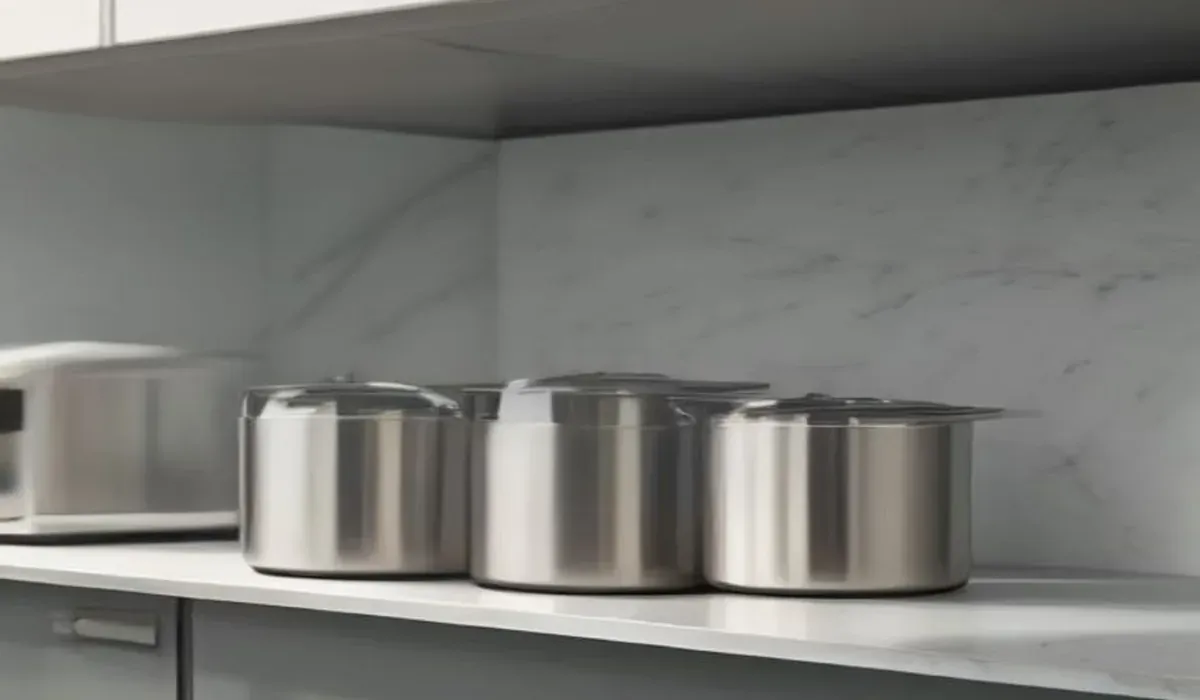
One honest caveat: the product page states capacity as "6–225 L, depending on size" and does not publish a per-size liter figure. Confirm the capacity of each configuration when you request a quotation, along with the size mix for your market. Every configuration carries two loop handles, and the catalogue image shows a fitted lid — confirm lid inclusion and specification at ordering.
Check the bottom, not just the number
## Check the bottom, not just the number
A capacity plan only holds if the pot survives the duty cycle, and at 100+ liter batch sizes the compound bottom does the heavy lifting. How to inspect the bonded layers at receiving is covered in our compound bottom stock pot buyer checklist; use it alongside the capacity table above before confirming an order.
Frequently asked questions
## Frequently asked questions
How do I convert my daily output into a pot capacity?
### How do I convert my daily output into a pot capacity?
Take the finished liters you need per cook cycle and divide by roughly 0.7 to allow for headspace and evaporation losses, then choose the nearest listed configuration and confirm its exact capacity at quotation. If the result crosses a burner or handling limit, split the daily output into two batches in a smaller pot instead of forcing one oversized vessel.
Which model should an importer stock for a mixed customer base?
### Which model should an importer stock for a mixed customer base?
Cover the ladder, not the extremes: YH-SSP-103 serves the small foodservice and retail-adjacent band up to 16 L, YH-SSP-102 covers the short-body mid range from 9 to 113 L, and YH-SSP-101 carries the tall-body range from 6 to 225 L for serious batch buyers. Review each model's size list against your customer mix before ordering.
Can wall thickness be paired with each size?
### Can wall thickness be paired with each size?
Body thickness options sit in the 0.6–1.2 mm series and compound bottom options in the 3.0–5.6 mm series; the exact size-to-thickness pairing is confirmed at quotation. Custom logo and packaging adjustments follow the factory's eight-step OEM process, so thickness, handles and branding can be aligned in the same enquiry.
Get a capacity plan matched to your kitchen or catalog
## Get a capacity plan matched to your kitchen or catalog
Send your batch sizes, target channel and destination market to sales@yihengcookware.com and we will return the recommended size mix across YH-SSP-101, YH-SSP-102 and YH-SSP-103 for quotation.