Sep 30, 2026Buying Guides
Compound-Bottom Stainless Stock Pots: A Wholesale Buyer's Checklist
A goods-level acceptance checklist for wholesale buyers: how to specify the compound bottom before you order, and how to physically verify stainless stock pots when the batch lands.
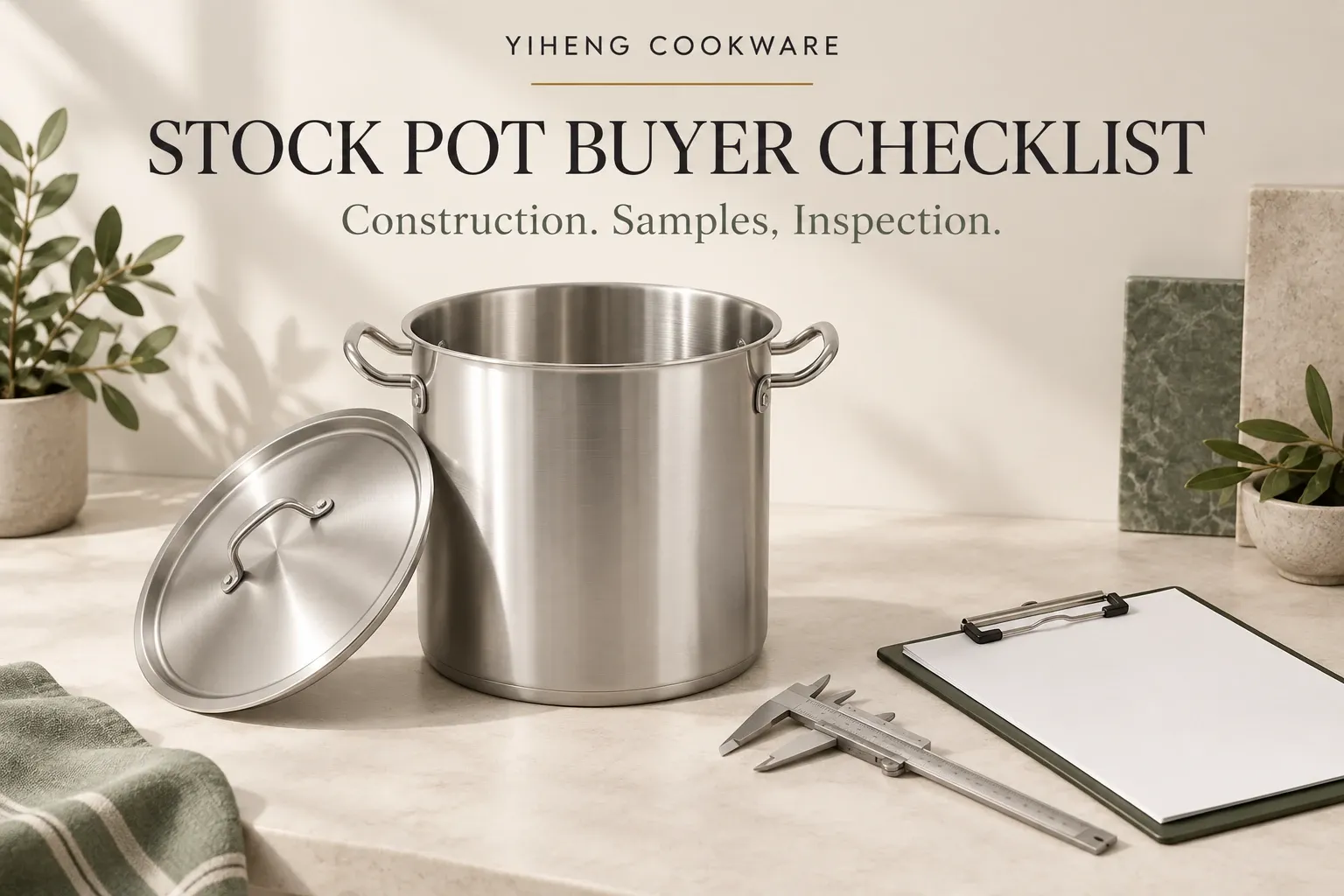
A goods-level acceptance checklist for wholesale buyers: how to specify the compound bottom before you order, and how to physically verify stainless stock pots when the batch lands.
How to use this checklist
This checklist inspects the goods: the specification you sign off before production, and the checks you run when a batch or arrival lot lands. It does not replace supplier qualification or a production-base audit. Review the supplier separately, then run this list at golden-sample sign-off and for each shipment; the table near the end doubles as a QC handout.
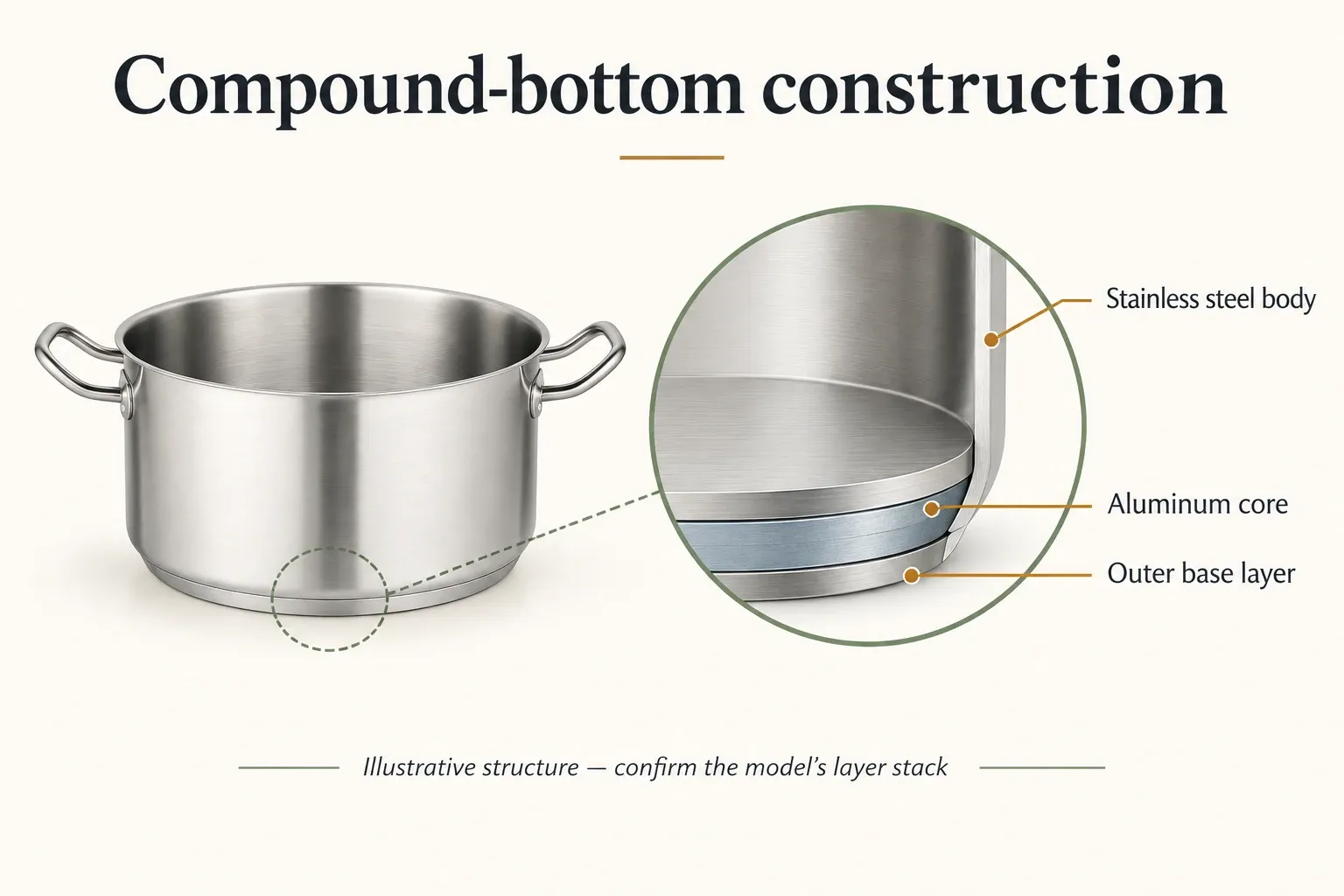
Compound bottoms: five questions to put to your factory
The compound bottom defines a stainless stock pot — the one part a photograph cannot prove. Get these five answers in writing before ordering:
- Which construction — a bonded compound (disc) bottom, a single aluminum base, or full clad?
- What is the exact layer stack — material and thickness per layer?
- Which layer spreads the heat, and — if my market runs induction — which layer is magnetic?
- What base flatness tolerance applies, and is it re-checked after heating?
- Which thicknesses pair with each diameter I am ordering?
Compound bottom vs. single aluminum base vs. full clad
A single aluminum plate bonded under a stainless body is the entry tier: economical, suitable for gentle simmering, and generally less even across large diameters. Full clad extends the layered structure up the walls and can spread heat more evenly, usually at the highest material cost of the three. A compound bottom concentrates the conductive core at the base and is a common construction for commercial stock pot lines.
The YH-SSC-101 casserole is the aluminum-base tier — 0.8 mm body over a 6.0 mm base — while the stock pot line below is built on compound bottoms. Match tier to duty: simmering stock forgives more than a line living on high heat.
The conductive layer — and the magnetic layer for induction markets
In a compound bottom the aluminum core spreads heat; the stainless skins provide food contact and corrosion resistance. If your market cooks on induction, the stack also needs a magnetic stainless layer — typically a ferritic floor on the outside of the base. A magnet gripping the sample confirms that layer exists, not that it is bonded — the arrival checks cover that.
Base flatness and stove contact
On flat-top and induction ranges, a warped base means rocking, hot spots, and slow boils. Straightedge the base at sample stage, then again after a full boil cycle — bond stress shows up as thermal warp. Write the tolerance you will accept into the purchase order, not at the dock.
Capacity ladder: plan the size run from the published size tables
Pot shapes stay out of scope — the sauce-pot-versus-stock-pot decision deserves its own shape-and-capacity guide. This is the size ladder only, using figures from our product pages:
Model | Body style | Sizes, dia × height (mm) | Capacity | Body / bottom (mm) |
|---|---|---|---|---|
Tall, commercial | 17 sizes, 200×200–600×800 | 6–225 L | 0.6–1.2 / 3.0–5.6 series | |
Short, commercial | 9 sizes, 250×180–600×400 | 9–113 L | 0.6–1.2 / 3.0–5.6 series | |
Tall | 11 sizes, 120×75–320×200 | 0.8–16 L | 0.6 / 3.0 | |
Short | 11 sizes, 120×50–320×110 | Confirm at quotation | 0.6 / 3.0 | |
Casserole, aluminum base | 240 / 280 / 360 dia. | 4.5 / 7.5 / 13.0 L | 0.8 / 6.0 |
Two notes. Thickness pairs with diameter — the commercial figures are published as series, and the exact pairing is confirmed at quotation. Most buyers anchor the ladder on one high-volume size, then add a step larger and one smaller; extra adjacent diameters split the same demand.
Lids and nesting: decide before the container is loaded
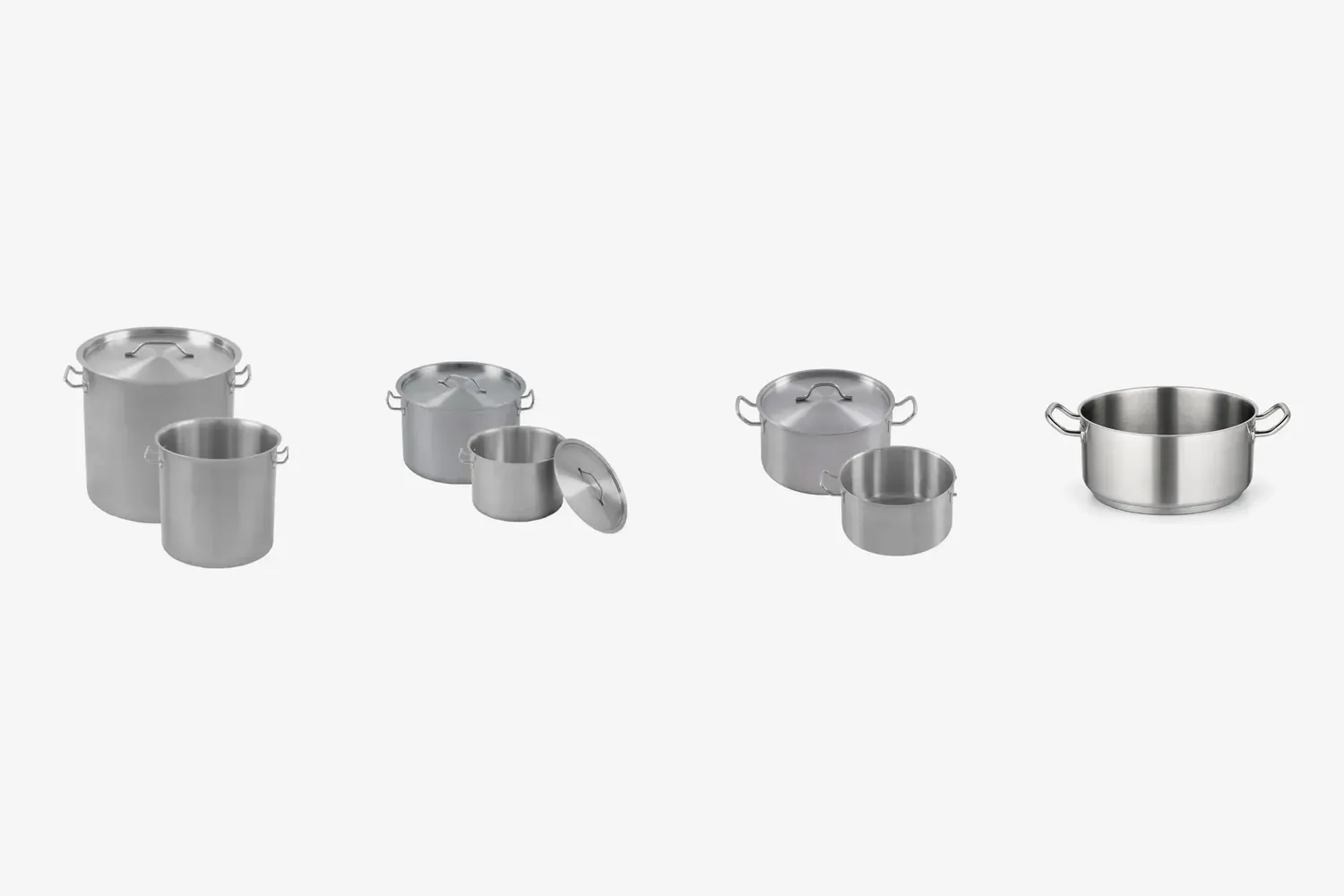
Flat and domed lids stack differently, and a universal lid — one cover across two adjacent diameters — cuts SKUs but risks a loose fit at the extremes. Stock pots ship nested, so whether lids pack inside the top pot or wrapped separately changes carton count and freight per unit. Catalogue images show fitted lids on the SSP line, but inclusion and specification are confirmed at quotation — state flat or domed, and which diameters, in the RFQ.
Handles: attachment and the full-load lift test
The SSP models carry two loop handles. Ask whether the attachment for your selected sizes is welded or riveted; either route needs a defined attachment standard. At inspection, check weld beads for porosity and rivets for movement, then fill the largest pot to the agreed test level and lift it as your customer's kitchen will. A pot that looks acceptable when empty but shows excessive movement under the agreed load needs further review.
Arrival inspection checklist
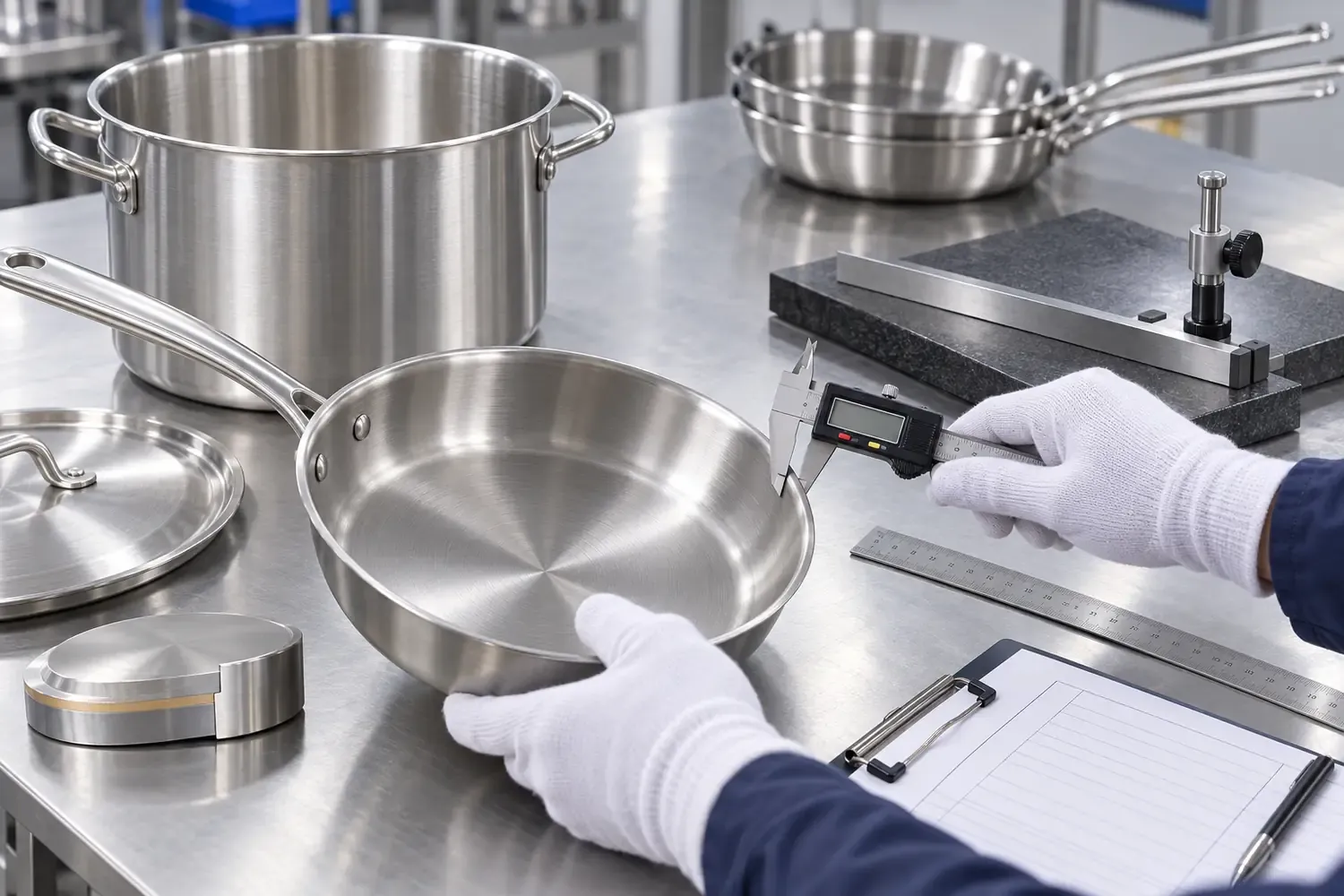
Run this at golden-sample sign-off and every production batch. Items 1–4 are the compound-bottom core; the rest catch claim drivers.
# | Check item | What to look at | Fail signals |
|---|---|---|---|
1 | Material documents | Layer-by-layer spec sheet and declaration, matching the PO | Missing paperwork; grade differs from the PO |
2 | Compound-bottom bond | Sectioned sample or exposed bond line: clean, parallel layers; tap the base | Hollow or buzzing sound; bond-line voids; base bulge or dome |
3 | Base flatness | Straightedge on a flat surface; repeat after a boil cycle | Rocking or spinning pot; daylight under the straightedge; warp after heating |
4 | Magnetic layer (induction) | Magnet test on the base, against your market's stove mix | No attraction where induction use was specified |
5 | Body thickness | Spot micrometer readings against the size's confirmed pairing | Readings consistently below the ordered spec |
6 | Welds and handles | Attachments complete and clean; full-load lift on the largest size | Cracked or porous welds; loose rivets; flex under load |
7 | Rim and lid fit | Lid seats and holds on a level pot; rim true round | Lid slides off a level pot; out-of-round rim; burred edges |
8 | Interior finish | Uniform polish, no pitting or residue; damp-wipe, re-check later | Free-iron rust specks; pitting; polishing compound in the seams |
9 | Packaging and nesting | Nested pots separated; lids protected; agreed carton stack | Scuffed nesting; unprotected lids; over-stacking deforming cartons below |
Test and certification paperwork
YIHENG provides certification support per market and model, subject to test reports. The SSP and SSC product pages note FDA and LFGB compliance options; requirements for your destination market are confirmed in the quotation. Request test reports with your golden sample, not after production — a document gap is cheaper to close before packing.
How production and QC are coordinated
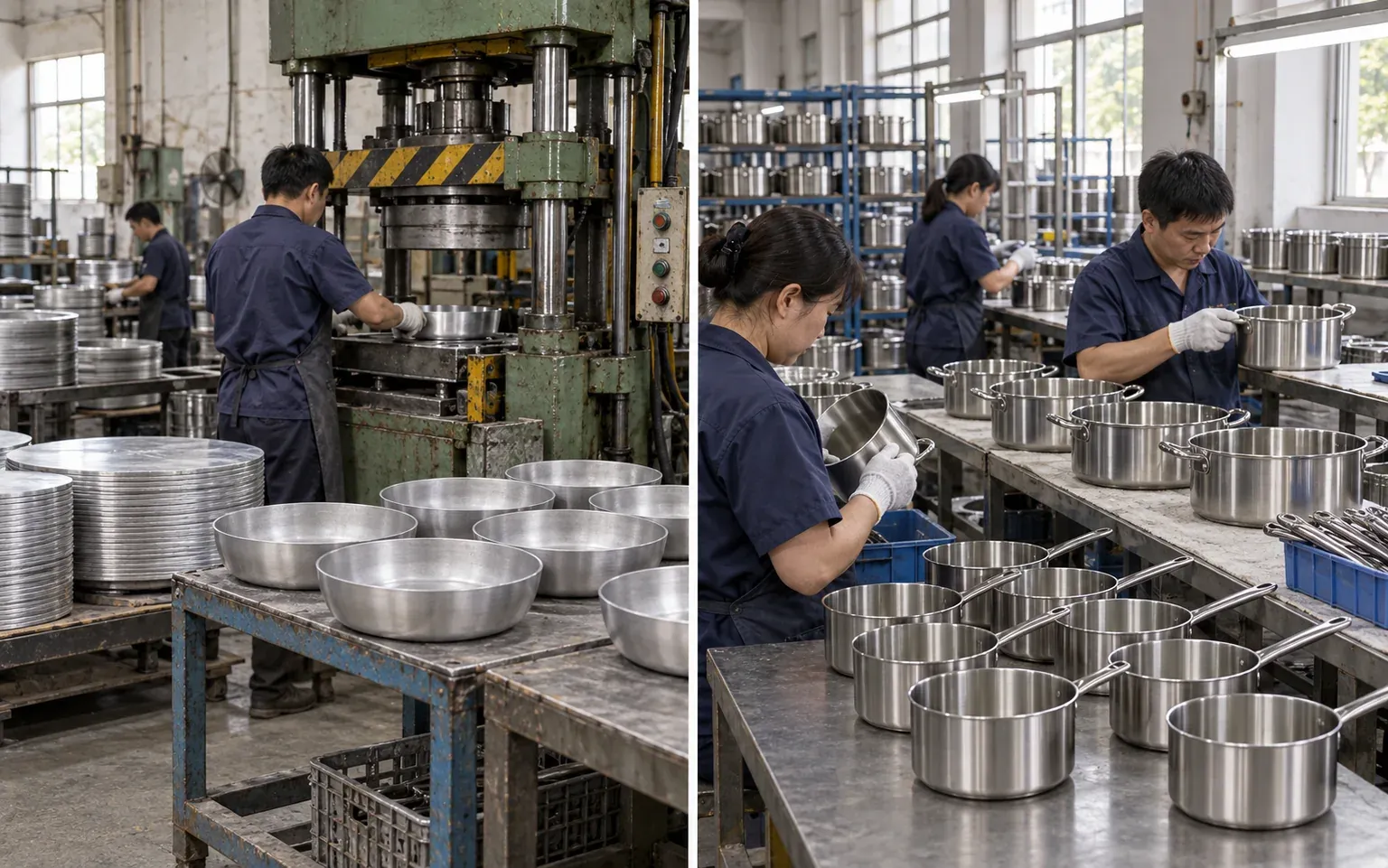
The applicable production route depends on the selected stainless steel model, dimensions, bottom construction, handle attachment, and finish. YIHENG coordinates the buyer brief and confirmed specifications with long-term partner production bases in Foshan and Jiangmen, then follows the agreed sample, in-process checkpoints, final inspection method, packaging, and shipment preparation. The checklist above can be converted into the order-specific inspection record used for the selected models.
Frequently asked questions
How do I verify a compound bottom is real and well bonded?
Use three checks together. Match the written layer stack to a sectioned sample or exposed bond line — clean, parallel layers, no voids. Weigh against the golden sample; a missing core shows on the scale. Tap for a solid note, not a buzz, and re-check flatness after a boil cycle, where bond failures show first.
Which model covers bulk soup production for foodservice?
The YH-SSP-101 tall commercial line is the anchor: 17 sizes from 200 to 600 mm diameter, published capacities of 6–225 L, and a 3.0–5.6 mm bottom series. Where clearance is tight, the YH-SSP-102 short line covers 9–113 L in nine sizes. Thickness pairing per diameter is confirmed at quotation.
Do lids come included with the stock pots?
The catalogue images show fitted lids, but inclusion and specification are confirmed at quotation. State flat or domed, which diameters need covers, and whether you want a universal-lid strategy; the lids are quoted with the pots.
Request the checklist and a stock pot quotation
[Request the Stock Pot Wholesale Inspection Checklist and quotation](https://www.yihengcookware.com/contact-us) — email your destination market, target sizes, stove mix, estimated quantity, and packaging requirements. We will review the relevant SSP/SSC size options, lid requirements, inspection points, and quotation details. You can also send the same brief through our contact form. Still choosing a line? Our carbon steel vs. stainless steel comparison explains where stainless steel fits in a broader cookware program.