Sauce Pots vs. Stock Pots: Choosing Stainless Shapes and Sizes for Commercial Kitchens
Stock pots are tall, two-handled vessels built for volume boiling; sauce pots are wider, single-handle pots built for reduction and sauces — here is how each shape, capacity range and handle
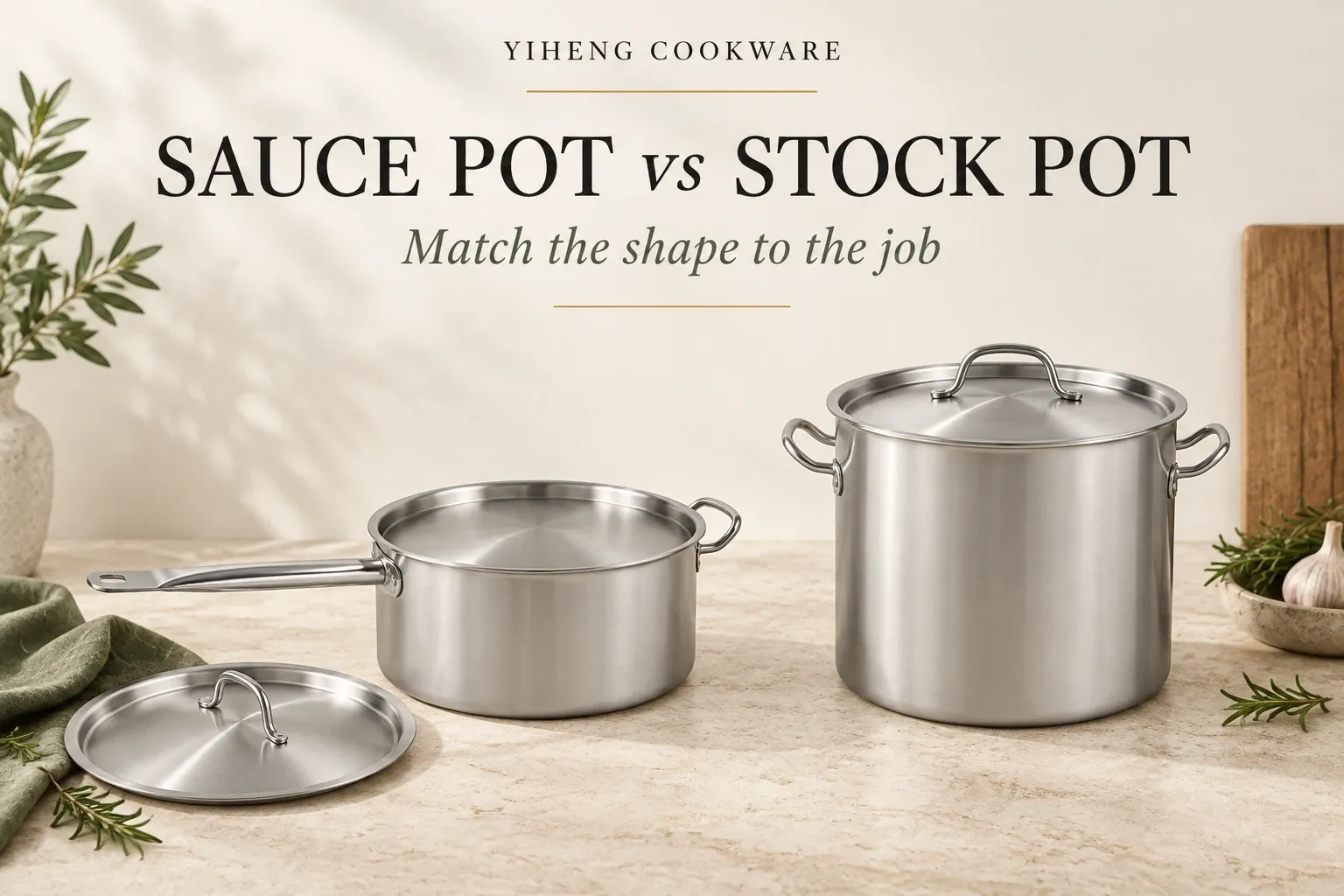
Stock pots are tall, two-handled vessels built for volume boiling; sauce pots are wider, single-handle pots built for reduction and sauces — here is how each shape, capacity range and handle configuration in our stainless steel line maps to your burners, storage and menu.
Quick Answer: Shape Follows Function
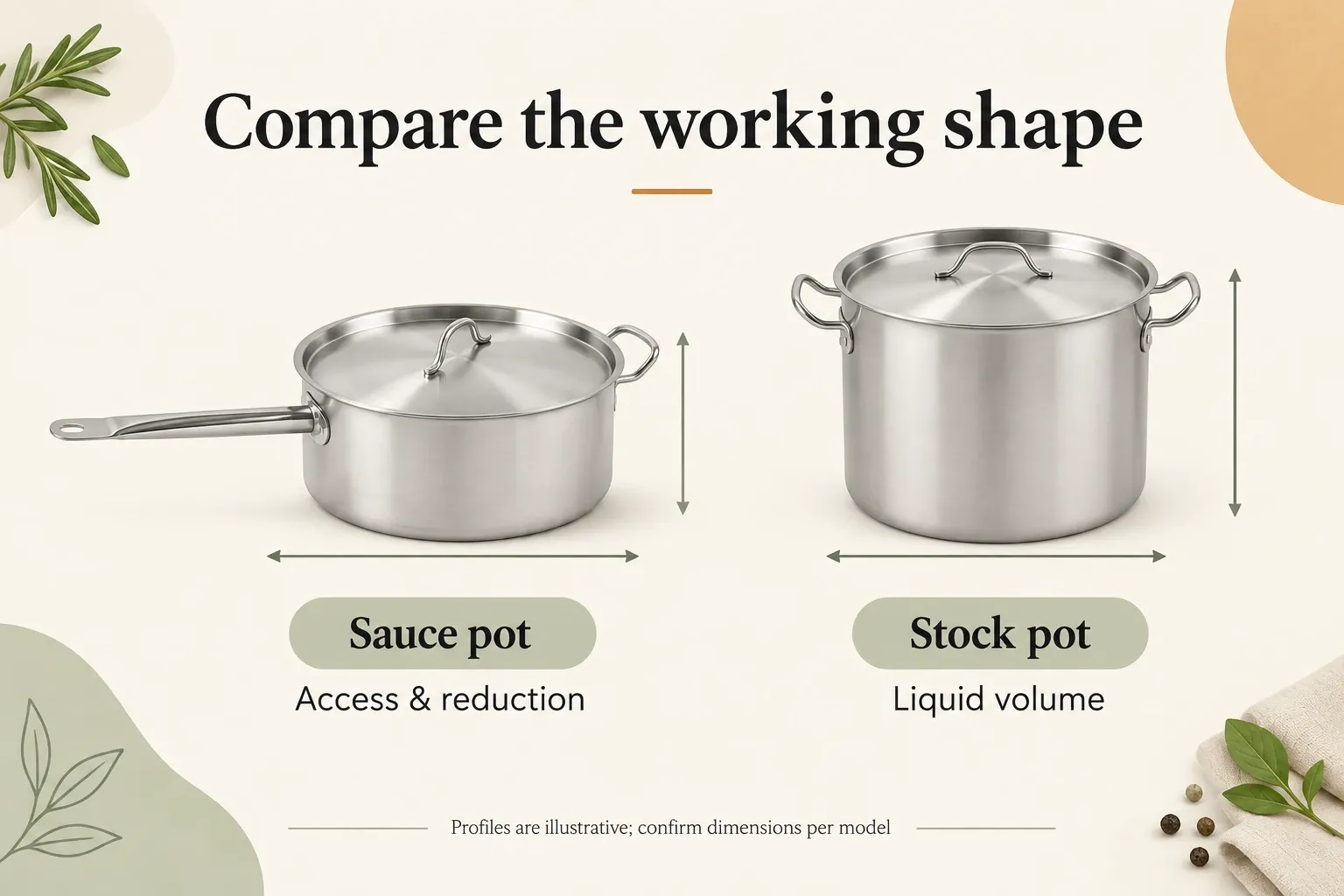
A tall body keeps liquid deep over the heat, evaporates slowly and holds temperature — a stock pot's job. A wide body exposes more surface, speeds reduction and leaves ladle room — a sauce pot's job. Every other difference, from handle style to shelf footprint, follows from that distinction. Our line splits cleanly along it: YH-SSP stock pots carry two loop handles; YH-SSA sauce pots carry a long metal handle. (Still weighing materials? Start with our earlier guide to carbon steel vs. stainless steel for commercial cookware.)
| Feature | Stock pot (YH-SSP line) | Sauce pot (YH-SSA line) |
|---|---|---|
| Body proportions | Tall cylinder; height matches or exceeds diameter on the tall model | Wider than it is tall in every published size |
| Capacity span | 6–225 L (tall); 9–113 L (short) | 0.8–16 L (compound-bottom models); 0.9–8.0 L (aluminum-base saucepan) |
| Handles | Two loop handles | Single long metal handle |
| Typical jobs | Batch boiling, pasta, blanching, holding | Reduction, sauces, braising, whisking |
| Diameter range | 200–600 mm | 120–320 mm |
Stock Pots: Tall Body, Two Handles, Built for Volume
The YH-SSP-101 is the classic tall commercial stock pot: in most of its 17 sizes the height matches the diameter, and the largest options run to 600 mm across by 800 mm high. Capacity spans 6–225 L, with body thicknesses in the 0.6–1.2 mm series and compound bottoms in the 3.0–5.6 mm series — exact pairing confirmed at quotation. Two loop handles carry the weight when a full pot needs two people; a fitted lid appears in the catalogue image, with inclusion confirmed at quotation.
Tall vs. Short Stock Pot Bodies
Same family, different footprint. A tall body concentrates volume on a small burner footprint, limits surface evaporation and holds temperature longer — but lifts higher and eats vertical shelf space. A short body trades height for diameter: easier to stir into, easier to reach with a ladle, lower center of gravity when full. The YH-SSP-102 is that short layout in 9 sizes, from 250 mm across by 180 mm high up to 600 mm by 400 mm, covering 9–113 L. Choose tall when volume and heat retention dominate; choose short when access, stirring and low clearance do.
Sauce Pots: Wider Base for Reduction, Sauces and Braising
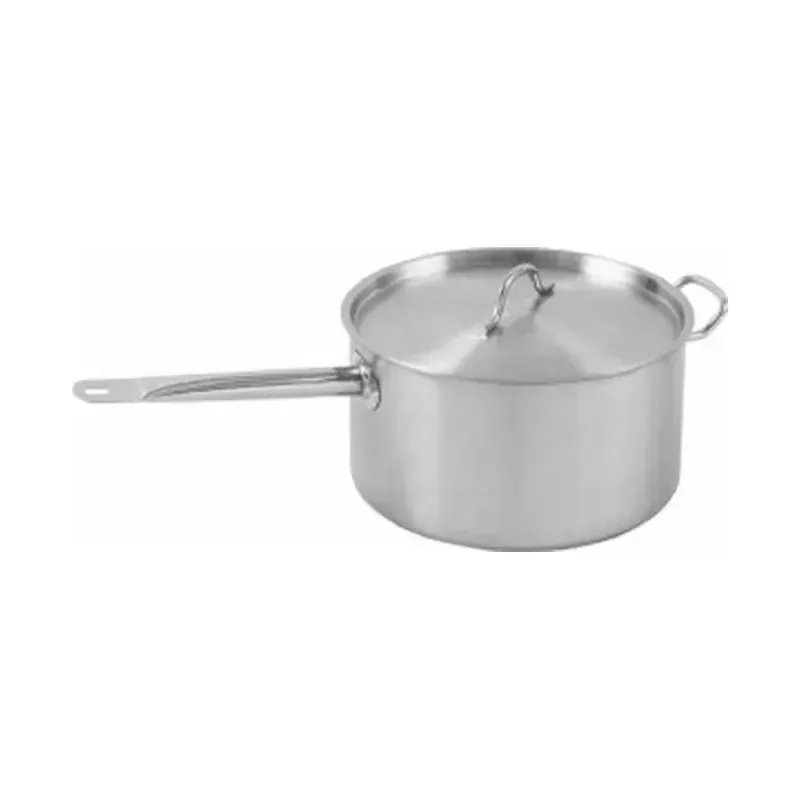
A sauce pot gives you floor area instead of depth. The broad base sears braising cuts in one layer, exposes more liquid surface so reductions move faster, and leaves ladle room at the shallow working depth. The YH-SSA-101 is the taller sauce pot in 11 sizes from 120 mm across by 75 mm high to 320 mm by 200 mm, holding 0.8–16 L. The YH-SSA-102 shares those 11 diameters in shallower bodies (50–110 mm high) for the fastest-access jobs. The YH-SSA-103 matches the SSA-101 geometry with a 3.0 mm compound bottom specified on the product page. For lighter sauce work, the YH-SSA-105 saucepan runs from 0.9 L to 8.0 L on a 6.0 mm aluminum base.
Handle Configurations: Single Handle vs. Dual Loop Handles
A single long handle is a chef-control feature: one hand tips, pours, whisks and stations the pot on one burner without clearing a second grip — hence the long metal handle across the YH-SSA line. Dual loop handles answer a different problem: mass. Once a pot holds tens of liters, one handle is a wrist injury waiting to happen; two loops let two cooks lift in balance and keep the profile clean for nesting — hence both stock pots. For menus in between — braises, casseroles, slow sauces in modest volume — the YH-SSC-101 casserole pan pairs two loop handles with a shallow 4.5–13.0 L body.
Matching Diameter to Burners and Storage
Diameter is where shape meets equipment. A pot base should sit inside the burner grate; a 320 mm sauce pot on a 200 mm ring wastes heat and scorches past the flame edge. Check grate spacing before fixing a size list — short, wide bodies need more burner width than tall, narrow ones at equal capacity. Storage mirrors the logic: loop-handle stock pots nest, shallow sauce pots stack in little vertical space, and tall bodies demand clear shelf height. For a distributor, nesting is shelf efficiency — more sellable units per meter of rack. Orders are consolidated by batch in our own finished-goods warehouse, so mixed shape-and-size programs ship as one coordinated consignment.
A Note on Bottom Construction: Compound Bottom
Every model above pairs a stainless body with either a compound bottom or an aluminum base — layered bases that spread heat evenly across the pot floor and, in the compound-bottom versions, keep the pot induction-friendly. That is the whole concept you need for shape selection; thickness values in the table below come straight from the product pages, and the deeper topic of what to check when inspecting compound bottoms at incoming QC is covered in its own inspection checklist guide — we keep the two subjects separate on purpose.
A Stocking Framework for Resellers
A minimum commercial range covers four axes: one tall body and one short body per family, one small capacity and one large capacity, at least one single-handle pot and at least one two-hand pot. Behind the catalogue, the stainless program runs on both spinning and stamping production lines with manual polishing and inspection stations, which is how consistency holds across a range this wide. Certification support per market and model, subject to test reports.
| Model | Family | Sizes | Capacity | Body | Bottom |
|---|---|---|---|---|---|
| YH-SSP-101 | Tall stock pot | 17 (Ø200–600 mm) | 6–225 L | 0.6–1.2 mm series | Compound, 3.0–5.6 mm series |
| YH-SSP-102 | Short stock pot | 9 (Ø250–600 mm) | 9–113 L | 0.6–1.2 mm series | Compound, 3.0–5.6 mm series |
| YH-SSA-101 | Tall sauce pot | 11 (Ø120–320 mm) | 0.8–16 L | 0.6 mm | Compound (thickness confirmed at quotation) |
| YH-SSA-102 | Short sauce pot | 11 (Ø120–320 mm) | Not published* | 0.6 mm | Compound (thickness confirmed at quotation) |
| YH-SSA-103 | Sauce pot, 3.0 mm bottom | 11 (Ø120–320 mm) | 0.8–16 L | 0.6 mm | 3.0 mm compound |
| YH-SSA-105 | Saucepan, aluminum base | 6 (Ø140–280 mm) | 0.9–8.0 L | 0.6–0.8 mm by size | 6.0 mm aluminum base |
*Capacity figures for this model are not published on the product page; unpublished size, thickness and capacity pairings are confirmed at quotation.
Size Selection Checklist
Before you fix an order, answer four questions:
- Menu first: what is the most frequent job — holding stock by the hour, or turning sauces by the service? That single answer usually decides stock pot versus sauce pot.
- Burner reality: what are your grate diameters and spacing? Match pot diameters to the burners they will actually sit on, not to a catalogue wish list.
- Storage and transport: what shelf height and rack depth will these pots live in, and will you rely on nesting to keep the footprint compact?
- Who lifts it: one cook at a burner station points to a long handle; shared, heavy lifts point to two loop handles.
Send us these four answers and we will return a concrete size list per model.
Frequently asked questions
What is the real difference between a sauce pot and a stock pot?
Proportions and handles. A stock pot is a tall cylinder — the YH-SSP-101's height matches its diameter in most sizes — with two loop handles, built for deep liquid volume. A sauce pot is wider than it is tall, with a single long handle, built for surface work: reduction, sauces and braising. The shapes exist because the jobs do.
At similar capacity, should I choose the tall or the short body?
Tall when you want slow evaporation, heat retention and a small burner footprint — stock holding, pasta water, blanching. Short when you want stirring access, fast evaporation or clearance under low shelves — braising, reductions, front-line sauce work. The YH-SSP-101 and YH-SSP-102 overlap in capacity range precisely so you can split the difference by body shape rather than by volume.
Do YIHENG stock pots ship with lids?
A fitted lid appears in the catalogue images for both the YH-SSP-101 and YH-SSP-102, but lid inclusion is confirmed at quotation along with size, thickness pairing and packaging. State the lid requirement in your inquiry so it is written into the order confirmation.
Get a Shape and Size Recommendation for Your Kitchen
Email sales@yihengcookware.com with the subject line "Stock pot / sauce pot selection – [kitchen type or market]" and tell us your primary use — soup, sauce or noodle service — plus your burner situation and destination market. We will reply with a shape-and-size shortlist drawn from the YH-SSP and YH-SSA lines, with the exact specifications per size confirmed for your order.