First-Time Cookware Importer: Building a Starter Assortment from One Factory
Your first order should buy verifiable turnover — one dependable volume model from each product line, confirmed in writing and consolidated into a single mixed container — not the lowest uni
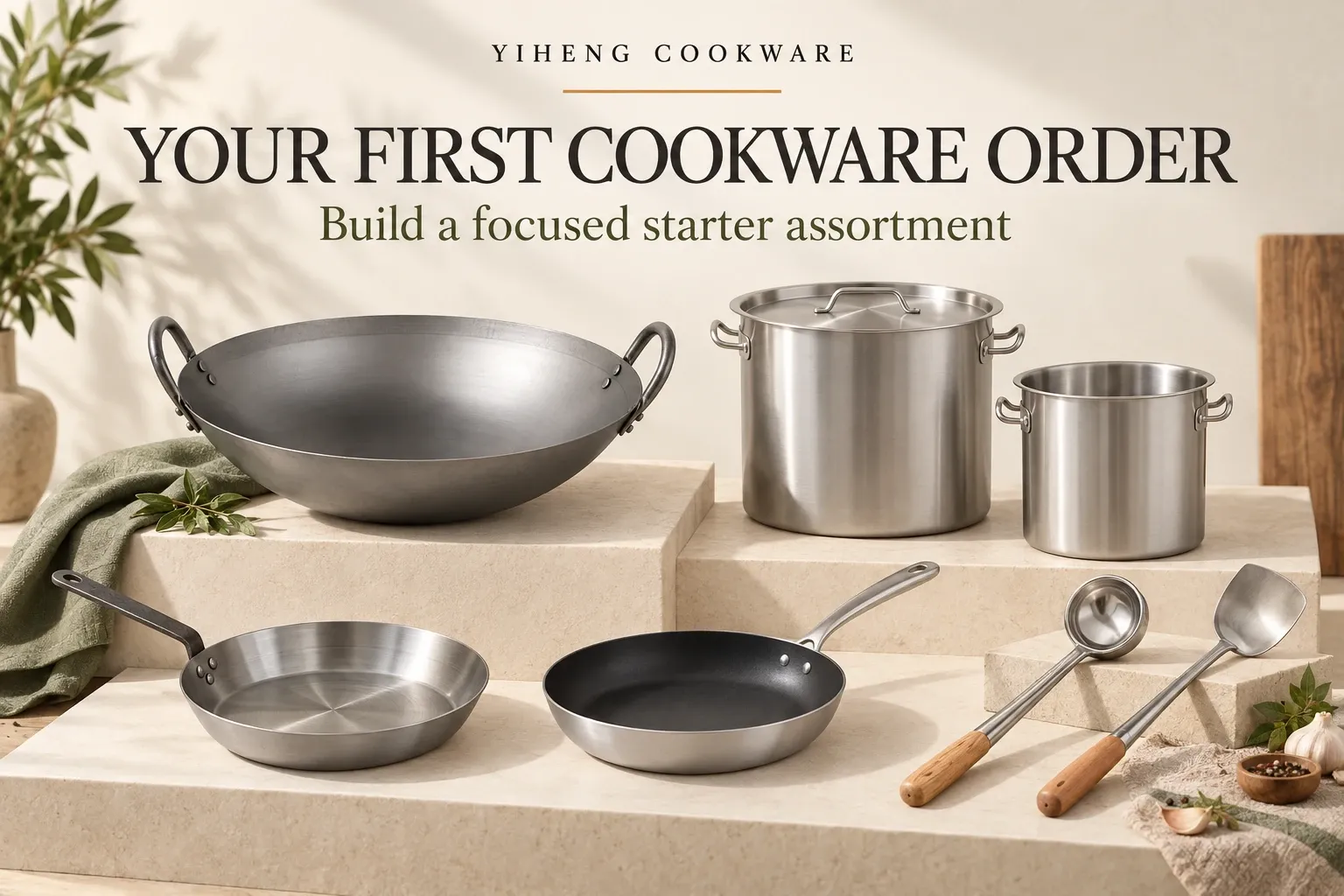
Your first order should buy verifiable turnover — one dependable volume model from each product line, confirmed in writing and consolidated into a single mixed container — not the lowest unit price you can find.
The 60-Second Takeaway: Your First Order Buys Proof, Not the Lowest Price
First-time cookware importers tend to fail in one of two ways: spreading a small budget across dozens of untested SKUs, or chasing the cheapest quote and watching the savings disappear in freight, delays and rework. The goal of a first order is narrower: a small, wide assortment that demonstrably turns over, from a supplier whose process you can inspect.
Generic guides say verify suppliers, start small, budget landed cost, inspect the goods. As the manufacturer, we turn each into a deliverable you can demand from us: approved samples, written specifications, in-production photo reports, warehouse staging before loading.
Three Checks Before You Commit to Anything
Food-contact compliance paperwork
Cookware touches food, so your market's food-contact rules apply from day one. We provide certification support per market and model, subject to test reports — FDA and LFGB compliance options are available on every model named below, confirmed in the quotation. Ask for documents tied to the exact model, not blanket claims about a catalogue.
Logistics: importer of record, HS classification, freight forwarder
You or your agent act as importer of record, classify each SKU under the correct HS/HTS code, and appoint a forwarder and customs broker. Duty rates change by market and category, so confirm current figures with your broker. The factory controls the export side: carton specifications, markings and the loading plan — packaging directly changes how much a container carries.
Landed cost: think in totals, not unit prices
Unit price is one line in a longer account: ocean freight, duties and taxes, inspection fees, inland haulage, and the carrying cost of a container that sits unsold. A marginally cheaper pan that fails inspection or arrives out of season is the most expensive pan you will ever buy.
The Starter Assortment: One Volume Driver from Each Line
YIHENG runs four product lines — carbon steel woks, frying pans (carbon steel and aluminum), stainless steel pots, and accessories. For a first container, take one generally proven, entry-volume representative from each line, plus one differentiator in your lead category:
| Line | Starter model | Role in the first container |
|---|---|---|
| Carbon steel woks — volume base | YH-CSW-201 | Machine-made double-handle wok, consistent spec |
| Carbon steel woks — differentiator | YH-CSW-302 | Pre-seasoned model with a retail story |
| Carbon steel fry pans | YH-CFP-030 | Mid-to-large 30 cm heat-intensive pan |
| Aluminum fry pans | YH-AFP-102 | Commercial lightweight foodservice line |
| Stainless steel pots | YH-SSP-101 | Compound-bottom tall stock pot |
| Accessories | YH-ACC-102 | High-turnover container filler |
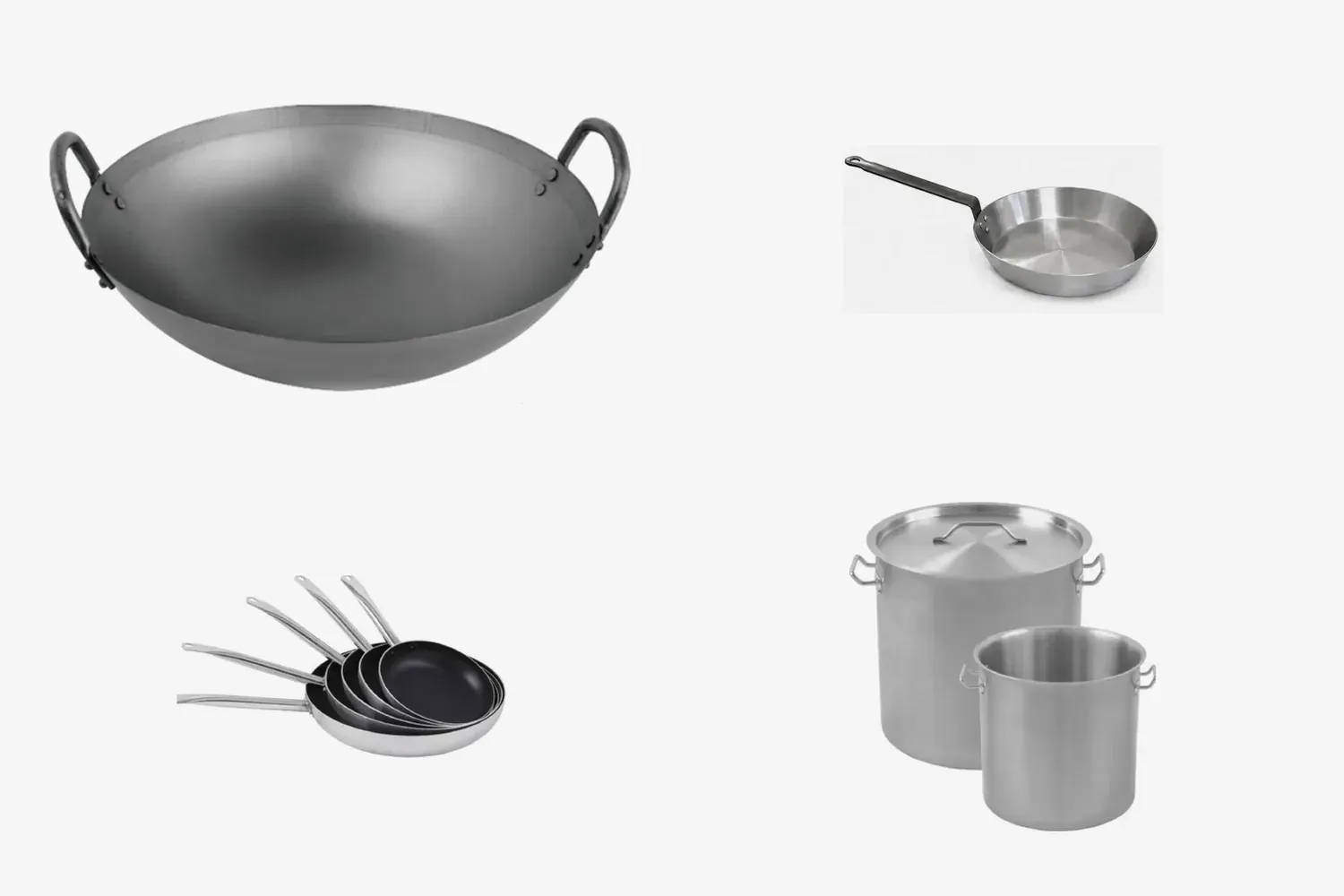
Wok line: a machine-made base plus one story model
The machine-made double-handle YH-CSW-201 is typically the volume backbone: one consistent specification across 10–16 inch sizes and 1.0/1.2 mm thicknesses, natural finish with rust-proof oil for storage and transport. Alongside it, the pre-seasoned wooden-handle YH-CSW-302 (32/34/36 cm) carries a selling point end customers understand immediately — it arrives with a factory-applied seasoned layer. Two SKUs, two jobs: dependable supply versus shelf differentiation.
Fry pan line: one carbon steel, one aluminum, two buyer groups
The 30 cm carbon steel YH-CFP-030 (1.6 mm plate, single iron handle, sand-polished finish) anchors the high-heat side of the shelf, while the commercial aluminum YH-AFP-102 (3.5 mm, long steel handle, ten sizes from 180 to 400 mm) covers lightweight, price-sensitive foodservice demand. One container, two materials, two customer types. How the two fry pan materials divide stations and arrivals is a planning call of its own — see our aluminum vs. carbon steel frying pan comparison.
Stock pot line: one compound-bottom tall pot
The tall compound-bottom YH-SSP-101 with two loop handles is the foundational piece foodservice and retail buyers recognize, spanning roughly 6 to 225 litres by configuration. For a first order you generally want one tall profile done well, not a full ladder of pot shapes.
Accessories: low ticket, high turnover, container filler
The wooden-handle stainless steel wok turner YH-ACC-102 (201 stainless steel with wood, six head sizes from about 10.2 to 13.8 cm) is the archetype: low unit value, quick turnover, cartons that fill gaps around heavy cookware. Accessories rarely justify a container alone — exactly why they belong in a mixed first order.
The logic: width before depth
This assortment validates width — four lines, six SKUs — without betting depth on any single guess. Once the market shows which line moves, deepen that line on the reorder. For sequencing sizes within your wok line once the width is set, follow the carbon steel wok size guide rather than guessing.
First-Order Risk Control, Step by Step
Every major first-order risk maps to a checkpoint you can demand in writing:
- Sample confirmation. Approve and keep a signed sample per SKU; everything afterwards is measured against it.
- Written specification and documents. Model, thickness, finish, handle, packaging, carton markings — plus food-contact documentation per market and model. If it is not written down, it is not ordered.
- In-production checks. Request milestone photo reports from the workshop, including the hand-polishing quality-inspection station, so problems surface while still cheap to fix.
- Pre-shipment inspection and warehouse staging. Every shipment passes a 100% pre-shipment inspection, and goods are staged in our own warehouse so all four lines are complete before loading.
From Sample to First Container: The Eight-Step OEM Process
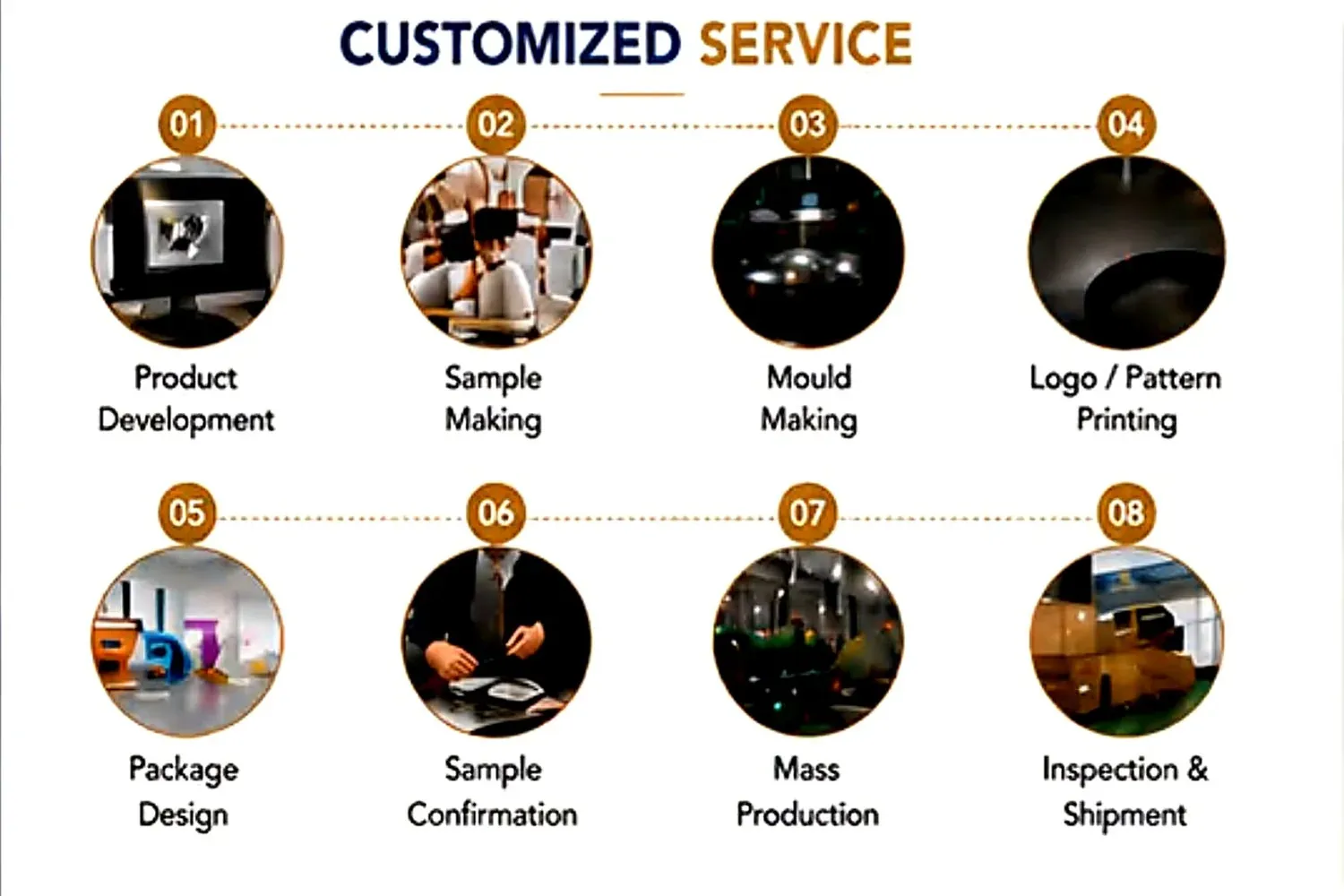
First orders run on our standard OEM program: an eight-step process from drawing confirmation to shipment, covering logo, packaging and specification adjustments. The checkpoints above lock onto its gates — drawing and sample confirmation at the front, in-production reporting in the middle, inspection and warehouse staging at the end.
Why One Factory for a First Order
Splitting a first container across several suppliers multiplies what a beginner is worst at verifying: multiple document sets, inspection trips and mixed-loading negotiations. From one factory with spin-forming and stamping lines under one roof, one quality standard at the hand-polishing inspection station, and its own finished-goods warehouse, a four-line mixed container ships as one loading plan, one document set, one accountable partner.
And "one factory" is only a good answer if it is the right factory — run factory due diligence before you commit, using the cookware manufacturer verification checklist.
Common First-Order Mistakes
- Going too wide. Width-first does not mean thirty SKUs — it means the four lines above until something proves itself.
- Comparing unit price only. The cheapest quote is rarely the cheapest container.
- Skipping inspection to save a fee. Inspection is the cheapest insurance in this trade.
- Leaving no reorder buffer. Budget the second order now, or you hand your momentum to a competitor.
Frequently asked questions
How many SKUs should a first cookware order include?
There is no universal number; it depends on channel and budget. The pattern that generally works is one volume driver per product line plus one differentiator in your lead category: in practice, around six SKUs across four lines, deepened on reorder only where the market responds.
How early should I plan the loading of a four-line first order?
At quotation stage, not at loading stage. Carton sizes differ between the four lines, and packaging geometry decides how much a container actually carries, so we build the mixed-loading plan while the specification sheet is being written. All four lines are produced and stored in-house and consolidated in our own finished-goods warehouse, which is what makes one-plan loading possible.
What documents should I request before my first shipment?
At minimum: the approved sample record, a written specification sheet per model, food-contact documentation — certification support per market and model, subject to test reports — and the pre-shipment inspection report with photos. Ask at quotation stage, not at loading stage.
Request a starter assortment proposal (first-order friendly)
Tell us your target market, channel (retail, foodservice or e-commerce) and rough container plan, and we will map a starter assortment across the four lines, document set defined up front. Request a starter assortment proposal (first-order friendly) — or ask for the OEM eight-step process one-pager to review the whole flow before you commit.