Shipping Cookware Overseas: Cartons, Pallets and Mixed-Container Loading from the Factory Side
How a cookware order travels from the production line to closed container doors — export cartons, shipping marks, palletized versus floor-loaded loading, and mixed-SKU containers — explained
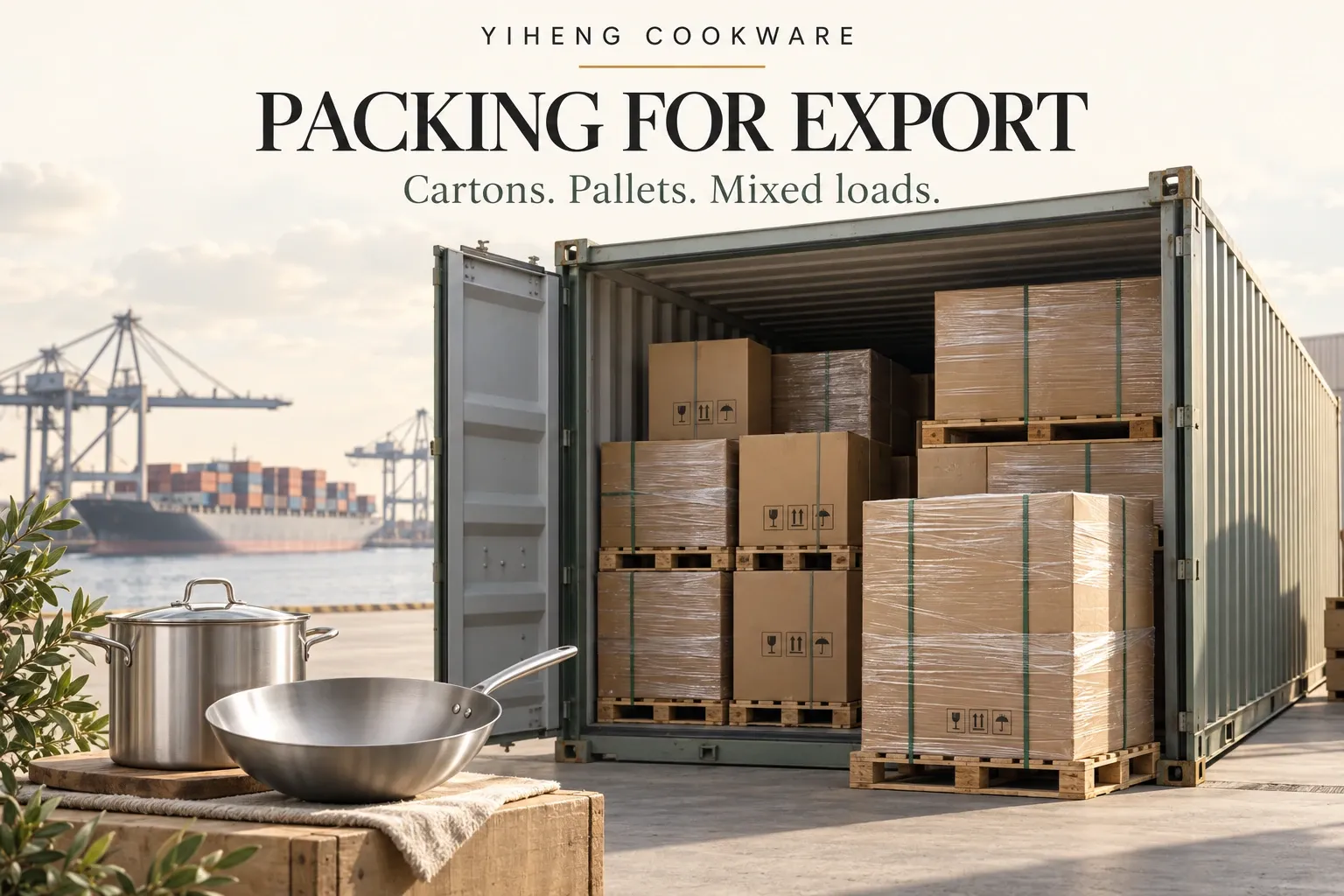
How a cookware order travels from the production line to closed container doors — export cartons, shipping marks, palletized versus floor-loaded loading, and mixed-SKU containers — explained from the factory side, with no freight-rate promises.
Search for advice on shipping cookware overseas and most results are freight calculators and forwarder marketing. The factory side — how goods are packed, marked, stored and loaded — is rarely described, yet first-time importers have the most questions about it. This article covers it: what happens after the purchase order, how export cartons and shipping marks work, how palletized and floor-loaded loading compare, and how a mixed container is planned. Freight rates and schedules are left out — those vary by lane and season, confirmed at booking.
What Happens After the PO: From Production Line to Packed Carton
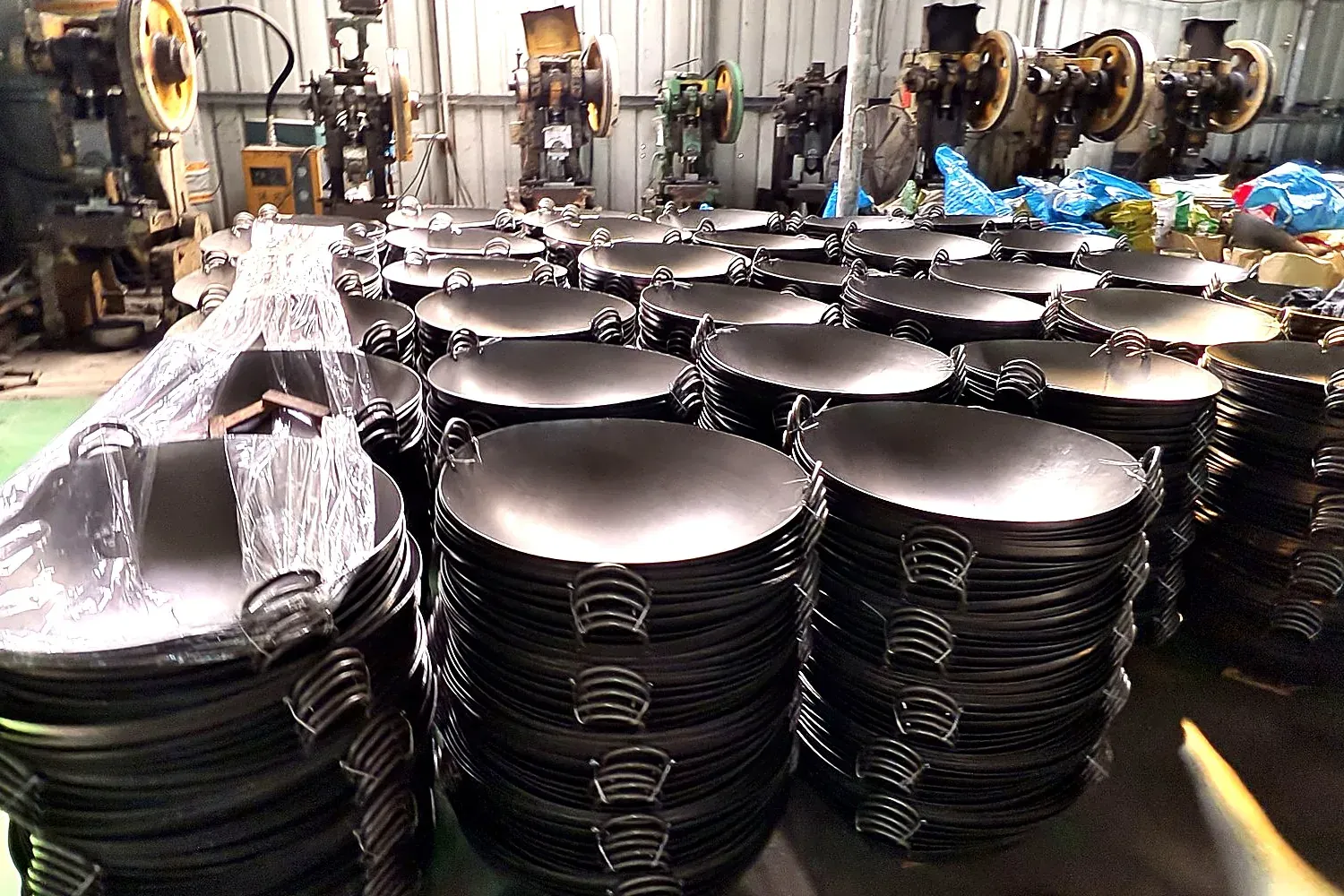
Once a purchase order and confirmed packing specification are in place, production starts. Carbon steel bodies are formed on our spinning and stamping lines, depending on the model. Before packing, finished pieces pass inspection — surfaces and weld points checked by hand at our manual polishing-and-inspection stations — and approved goods move to the finished-goods warehouse, batched per order.
Packing follows a fixed route: units boxed, inner boxes counted into master cartons, cartons sealed and marked, staged for loading. What matters is that every step is agreed before the first carton is sealed.
Export Cartons Explained: Inner Box, Master Carton and Shipping Marks
Cookware export packing normally has two carton layers:
- Inner box — the unit-level box: printed retail or plain brown, depending on whether goods go to a shelf or to a repacking distributor.
- Master carton — the export unit. A fixed number of inner boxes goes into one corrugated master carton, the unit your forwarder, warehouse and insurer all count. Its size, strength and weight belong in the packing specification, not at the dock.
Shipping marks are the identifiers printed on the master carton. General industry practice combines some of: a consignee or buyer code, the PO or contract reference, a carton sequence number, gross weight, carton dimensions, destination port and handling symbols. There is no mandated format — we print the layout you confirm as part of the packing specification.
A cookware-specific note: natural-finish carbon steel woks such as the YH-CSW-201 machine-made double-handle wok are protected with rust-proof oil, and cartons are closed to keep that protection intact through ocean transit — finish and packing choices are linked.
Palletized vs. Floor-Loaded: Two Ways to Fill a Container
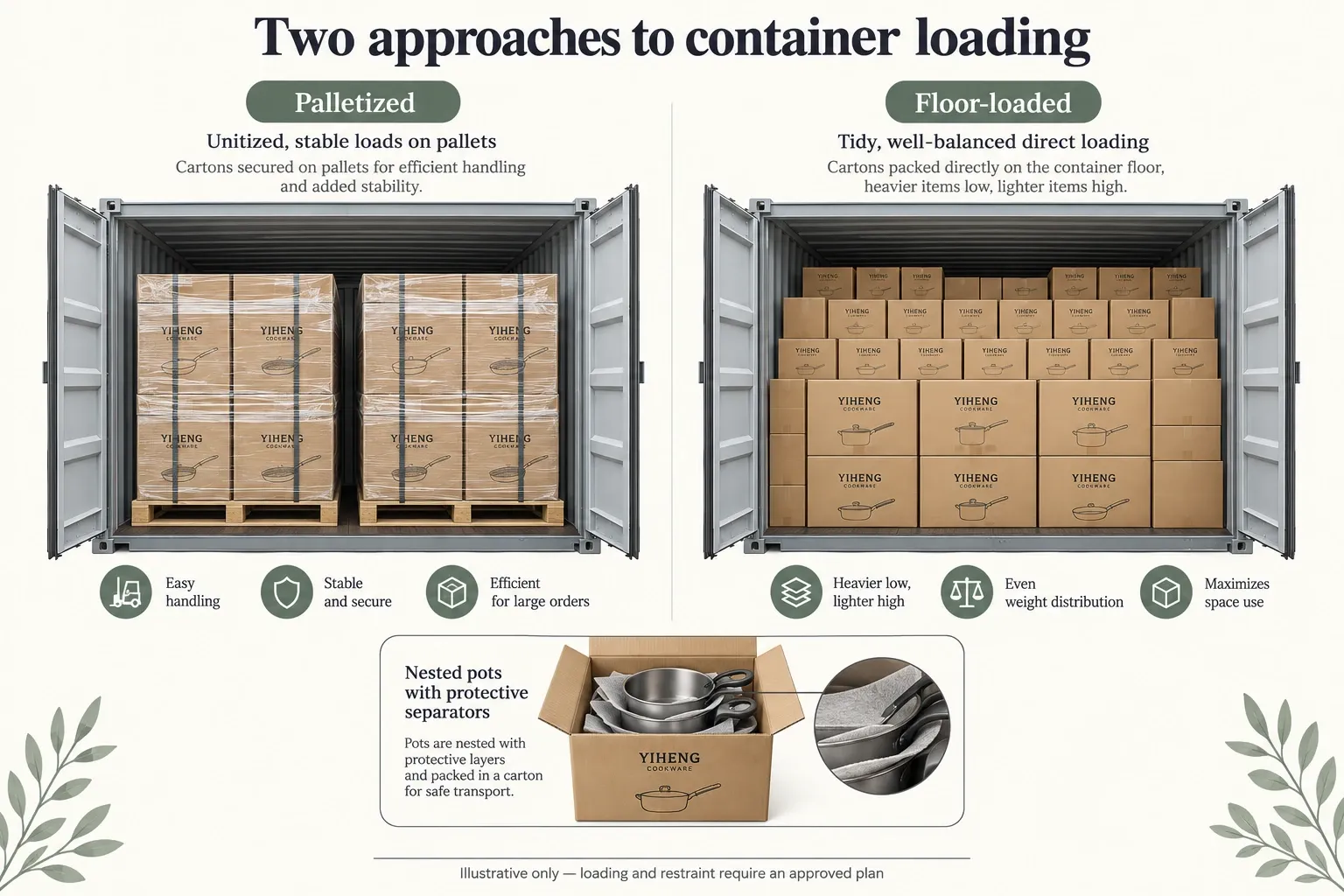
There are two common ways to fill a 20- or 40-foot container, and cookware ships both daily.
| Palletized loading | Floor-loaded (loose) loading | |
|---|---|---|
| How the container is filled | Cartons stacked on pallets, moved in and out by forklift | Cartons hand-stacked directly against the container floor and walls |
| Space utilization | Lower — pallet footprints and stacking gaps consume usable cube | Higher — cartons conform to the container |
| Loading and unloading speed | Faster at both ends; forklift handling | Slower; cartons handled piece by piece |
| Demands on cartons | Less direct crushing; the pallet carries the stack | Cartons must bear the full stack above them |
| Typical fit | Mixed orders, destinations with pallet handling, goods moving into a racked warehouse | Dense, uniform, nestable goods where cube utilization matters most |
Neither option is "correct." Pallets cost cube but save labor and re-handling at destination; floor loading uses nearly the full box but needs strong cartons and more time at both ends. Container internal dimensions are broadly standardized — a 40-foot high-cube is roughly 2.35 m wide and about 2.69 m high inside — so the geometry is predictable. The right choice depends on product mix, carton strength and destination handling, and any cost impact varies by lane and season, confirmed at booking.
How a Factory Plans a Mixed-Container Load
Most first orders are not one product — woks, stock pots and accessories often share one container, and mixed-container loading is a standard capability on our side. The planning logic:
- Heavy low, light high: dense items form the bottom layers, lighter cartons go above.
- Nest first, pad second. Cookware loads well because it nests — pots of graduated diameters sit inside one another, which is why a tall stock pot like the YH-SSP-101 is an efficient full-container product, always padded so pieces do not rub in transit.
- Uniform cartons stack cleanly: the machine-made YH-CSW-201 gives consistent dimensions, so its cartons stay uniform and the stack stays square.
- Accessory cartons fill the gaps — small parts go into leftover voids instead of riding as a loose top layer.
The full loading plan — which SKU goes where, in what sequence, with which marks, palletized or floor-loaded — is drafted here and confirmed with you before loading day. Expect to approve it, not discover it at the container door.
Documents to Expect Around Loading
Your forwarder owns most of the paperwork. On the factory side, expect a packing list (carton count, weights and dimensions per carton), a commercial invoice, and a shipping mark confirmation so carton marks match your documents. If your market requires compliance paperwork, we provide certification support per market and model, subject to test reports — flag it before production, not on loading day.
Why Finished-Goods Storage Matters Before Loading
Between "production finished" and "container loaded" lies the stage that decides whether loading day is calm or chaotic: storage. Completed orders wait in our own finished-goods warehouse, batched per order, so mixed SKUs can be consolidated, finally counted and staged indoors before the truck arrives — your last practical checkpoint, since a count or mark correction is far easier on a shelf than inside a sealed container.
Questions to Ask Any Supplier Before Loading Day
Most of these apply to any supplier you evaluate, not only to us:
| # | Ask before loading day | Why it matters |
|---|---|---|
| 1 | Will inner boxes and master cartons follow the packing spec I approved? | Prevents quiet substitution of thinner cartons or inner boxes |
| 2 | What exactly will the shipping marks say, and who approves the layout? | Marks drive sorting and receiving at destination |
| 3 | Do you recommend palletized or floor loading for my mix, and why? | Forces the space-versus-handling trade-off into the open |
| 4 | Which of my products nest, and how will voids be filled? | Cube efficiency and transit protection in one answer |
| 5 | Where do finished goods wait between packing and loading? | Indoor batch staging makes a one-session load possible |
| 6 | Will I receive the packing list before the container is stuffed? | Your last chance to reconcile counts against the PO |
| 7 | Can I get photos of the actual loading, not only the packed goods? | Shows how cartons actually entered the container |
| 8 | Who signs off the loading plan, and when do I see it? | The plan should be confirmed before loading day, not after |
Verifying the factory itself rather than its loading plan? Our checklist on how to verify a cookware manufacturer before an OEM order covers that earlier stage; commercial terms sit outside this article on purpose.
Frequently asked questions
Can I mix different cookware products in one container?
Yes — mixed-container loading is standard for us. Woks, stock pots and accessories can share one container, planned heavy-low and light-high, nesting products positioned first, accessory cartons filling gaps. You approve the loading plan before loading day; freight itself varies by lane and season, confirmed at booking.
Should my container be palletized or floor-loaded?
It depends on your product mix, carton strength and destination handling. Palletizing favors handling speed; floor loading favors cube utilization. We recommend an option based on your confirmed packing plan, and the cost difference, like all freight costs, varies by lane and season, confirmed at booking.
What do you need from me to prepare a packing and loading plan?
Three things: your product mix with approximate carton counts, your shipping mark information (consignee reference, PO number, destination port), and any pallet constraint at your end. You will get back a packing specification and a loading plan framework for the container type.
Get a Packing and Loading Plan for Your Order
Email sales@yihengcookware.com with the subject line "Packing & loading plan – [your product mix]". Include your product categories and approximate carton counts; we will reply with a packing specification and a loading plan framework. Freight is not part of that reply — it is quoted by your forwarder, or by a forwarder we help you contact, and varies by lane and season, confirmed at booking.