Enamel Carbon Steel Woks: Where They Sell and How to Position Them
A vitreous-enamel finish turns a carbon steel wok into a "no seasoning required" product with real shelf and gifting appeal — this guide maps the channels where enamel woks generally sell be
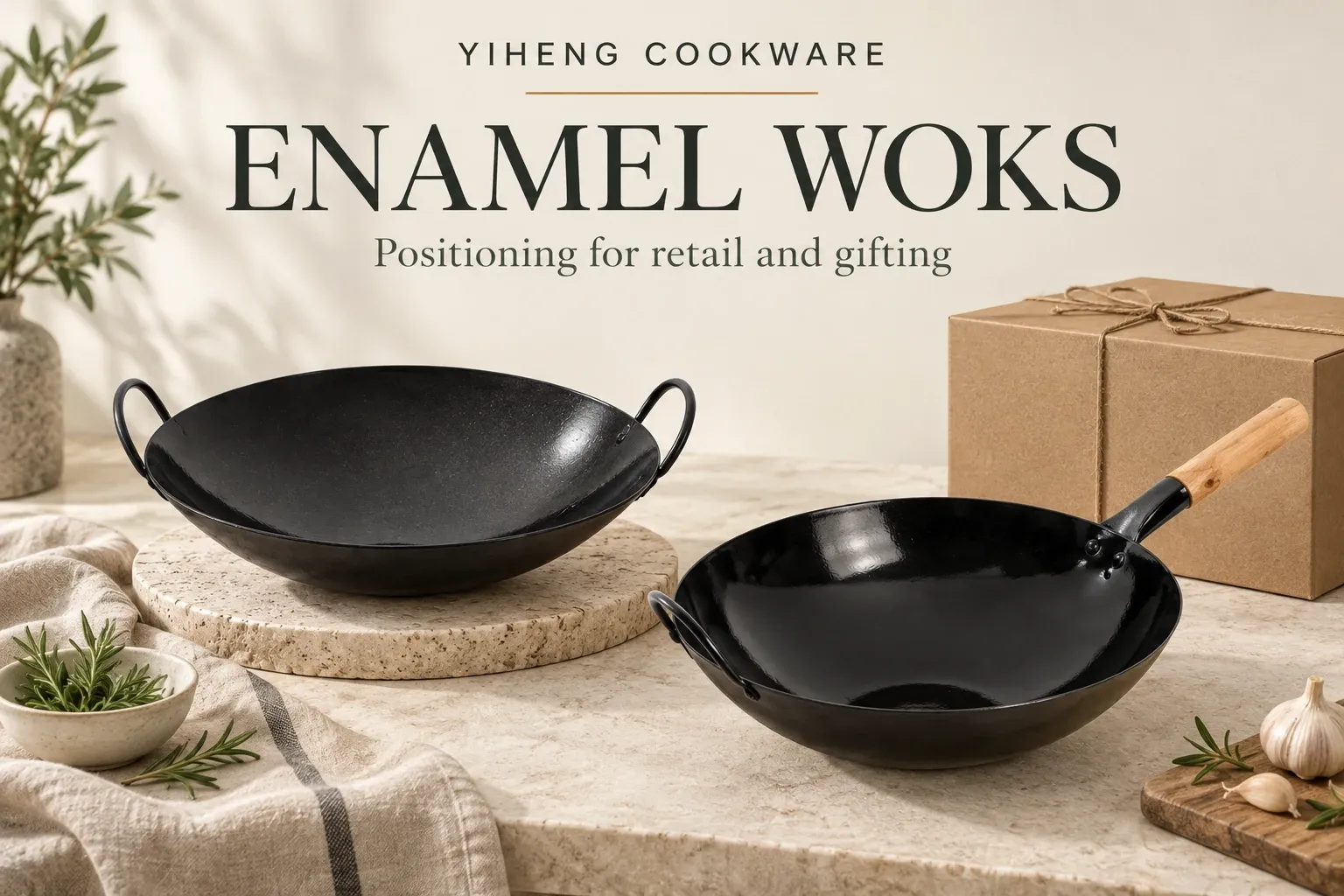
A vitreous-enamel finish turns a carbon steel wok into a "no seasoning required" product with real shelf and gifting appeal — this guide maps the channels where enamel woks generally sell best, how they share a catalog with pre-seasoned and natural-finish lines, and what importers should confirm before adding one.
What enamel over carbon steel actually changes
Carbon steel is the standard wok substrate because it heats quickly, stays light relative to its diameter and forms cleanly into deep, rounded pans. Its one historical drawback sits with the end customer: raw carbon steel arrives unprotected and asks for an oil seasoning routine before first use — and against rust in humid kitchens.
Vitreous enamel changes that equation. It is a glass-based coating fused over the formed steel panel, and it does three things a bare or pre-seasoned surface cannot:
- It removes the seasoning step. The enamel layer seals the steel, so the wok is ready to cook in out of the box — the single most repeated selling point across consumer enamel cookware listings.
- It makes cleaning simple. A smooth glass surface wipes clean; there is no patina to protect while washing.
- It carries color. Enamel accepts colored finishes, so an enamel wok can be merchandised as cookware and as kitchen decor at the same time.
The trade is equally real: enamel is chip-sensitive if knocked, and it gives up the "builds a patina with use" story that carbon steel enthusiasts look for. That trade is exactly why enamel is a positioning decision rather than a universal upgrade — which is what the rest of this guide is about.
Where enamel woks sell best
Consumer listings for enamel cookware cluster in lifestyle retail — houseware chains, gift catalogs and color-driven online stores — rather than restaurant supply. Third-party research firms also publish enamel cookware market reports, useful background for category conversations (verify any figures against the source before they enter your business case). For an importer, the signal is simple: enamel is a channel product that earns its slot in three kinds of program.
Decorative retail and houseware aisles
In houseware retail, an enamel wok is often displayed where customers browse with a decorating mindset — open shelving, island tables, tableware adjacencies. Color does the selling, and the wok doubles as visible kitchen decor between cooking sessions. Single-handle formats with wooden handles read especially well here, because the handle reinforces a "designed object" impression rather than a "pro tool" one.
Gift programs and seasonal catalogs
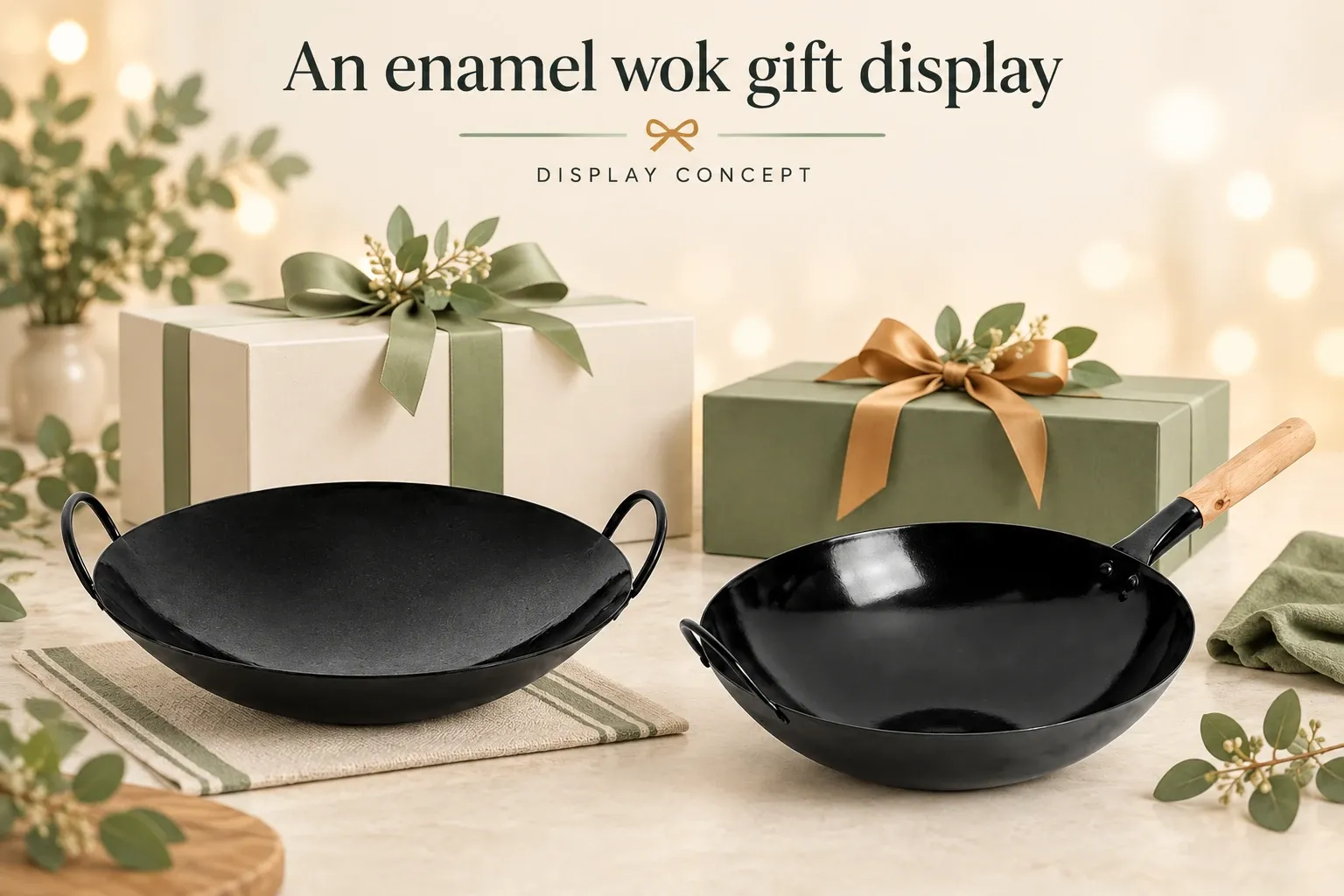
Gift buyers have a problem specific to carbon steel: telling a wedding or housewarming recipient "season this before you cook" is an awkward line on a gift card. Enamel removes it. "No seasoning required," plus a colorway that photographs well, makes enamel woks a natural fit for registries, housewarming sets and holiday catalogs — and one accepted colorway makes follow-up colors repeat-gift opportunities.
Online DTC resellers and social-commerce color stories
Online, the product photo is the shelf. Enamel's color range gives resellers a visual edge that grey steel cannot match, and "no seasoning required" works as the standard listing headline because it answers the first question a new cook asks. Unboxing videos and color-consistent sets perform strongly in social commerce. One caution: expectation-setting in the listing — a convenience product, not a high-output wok-hei machine — is what keeps return rates sane.
Shelf positioning: enamel vs pre-seasoned vs natural finish
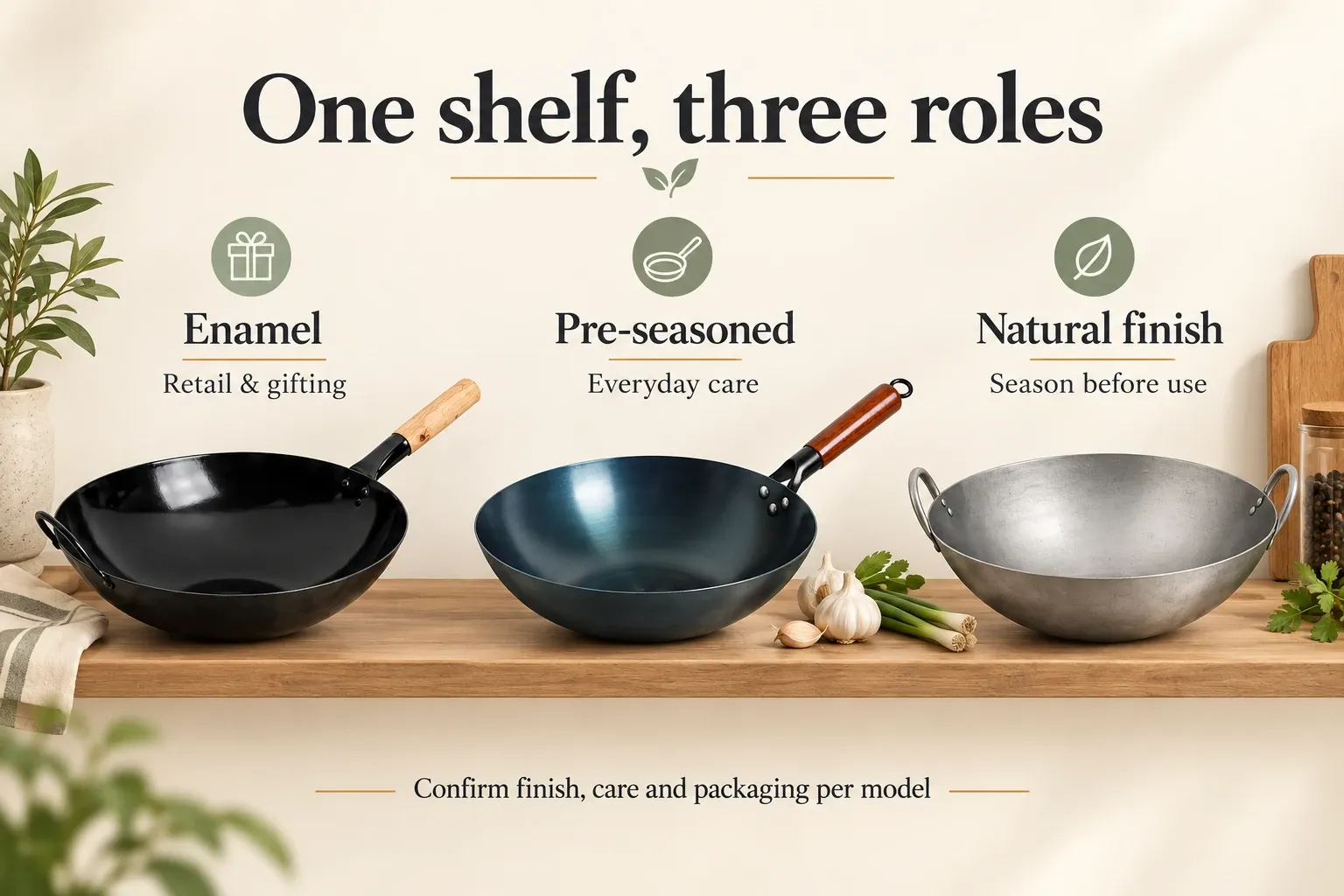
One shelf, three jobs
If you already carry pre-seasoned or natural-finish woks, the goal is not to replace them but to give each finish a distinct job so the three do not cannibalize each other:
| Finish | Shelf job | Typical channel | Core message | Care story on the label |
|---|---|---|---|---|
| Enamel | Decorative, ready-to-use piece that sells on color and convenience | Houseware retail, gift and seasonal catalogs, online color stories | "No seasoning required" | Wipe-clean surface; avoid knocks and thermal shock |
| Pre-seasoned | Ready-to-cook everyday wok that improves with use | Cookware aisles, general retail, online marketplaces | "Seasons with use" | Standard carbon steel upkeep |
| Natural finish | Traditional, professional-grade workhorse | Restaurant supply, professional channels, enthusiast retail | "Pro kitchen workhorse" | Full seasoning routine |
Message per position
Each shelf message addresses a different buyer, so mixing them muddies all three. "No seasoning required" converts gift buyers and first-time cooks. "Seasons with use" converts everyday cooks who like the idea of a pan improving with use. "Pro kitchen workhorse" converts buyers equipping lines that serve covers at speed. For the underlying finish mechanics — what factory pre-seasoning is and how it differs from a raw natural finish — see our earlier guide on pre-seasoned vs natural finish carbon steel woks; that article covers the seasoning decision, this one the shelf placement.
Buyer considerations before adding an enamel wok line
Chip awareness and honest shelf talkers
Enamel can chip when the rim or edge takes a knock, and it is generally not the surface to specify for high-frequency commercial tossing over roaring burners. Neither point kills the category — it just means the product belongs in programs where decor and convenience drive the purchase. Honest shelf talkers ("a coated wok for everyday home cooking; hand wash; take care not to knock the rim") cost nothing and are the best defense against returns-driven reviews.
General enamel care notes to pass to end customers
The notes below are general enamel cookware commonplaces rather than product-specific instructions — adapt the wording to your market and packaging:
- Avoid knocking the rim or body against hard surfaces and other pans.
- Avoid thermal shock: let the wok cool down before it meets cold water.
- Prefer wooden or silicone tools over metal ones to protect the surface.
- Mild hand washing is the safe default recommendation; dishwasher habits vary by household and market.
Colorways, branding and packaging feasibility
Color availability, logo printing and packaging options are confirmed per model through sampling and the proforma invoice (PI) — they are not standardized claims you can copy into a catalog. Until the PI states it, treat every colorway claim as "to be confirmed at sampling."
YIHENG enamel carbon steel wok line
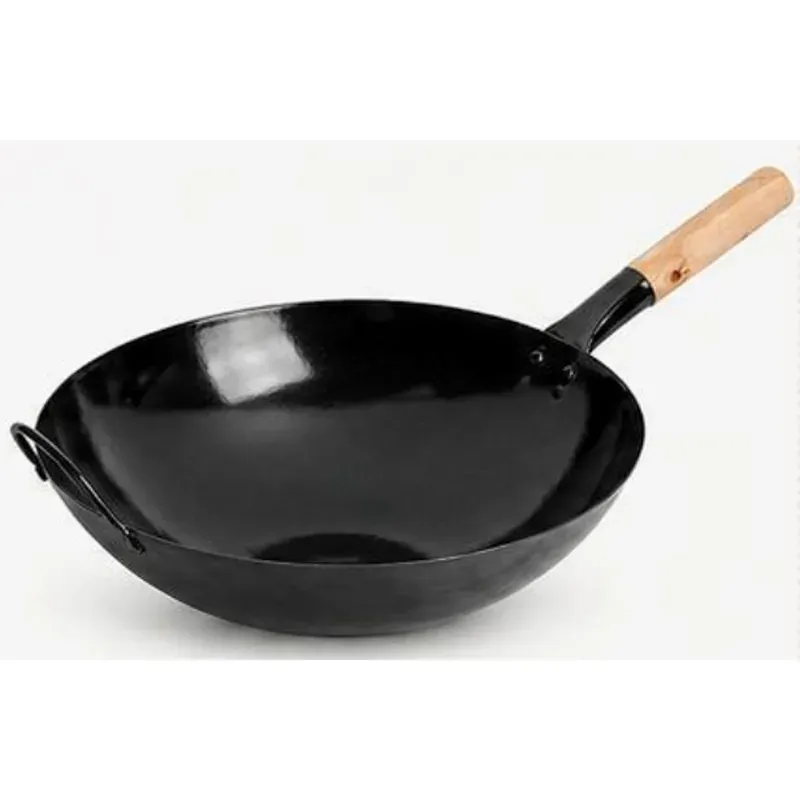
YIHENG offers the enamel finish on two carbon steel wok formats:
| Model | Body | Surface | Available sizes | Thicknesses | Handle |
|---|---|---|---|---|---|
| YH-CSW-501 | Carbon steel | Enamel | 12, 13, 14, 15 and 16 in | 1.0 / 1.2 mm | Wooden handle |
| YH-CSW-502 | Carbon steel | Enamel | 12, 13, 14, 15 and 16 in | 1.0 / 1.2 mm | Double loop handles |
The single-handle YH-CSW-501 suits gift and houseware programs where a wooden handle carries the decor story; the double-handle YH-CSW-502 suits two-handed carrying and serving-friendly presentation. Both support OEM and ODM customization of logo, packaging and specification through an eight-step OEM process, with 100% pre-shipment inspection before dispatch. Certification support is available per market and model, subject to test reports.
Frequently asked questions
Do enamel carbon steel woks need seasoning?
No — that is the core selling message of the finish. The vitreous enamel layer seals the steel body, so there is no oil-seasoning routine before first use and no patina to maintain. It is generally the deciding feature for gift programs and first-time cooks.
Are enamel woks a good fit for commercial kitchens?
Generally not for high-volume wok stations. Commercial lines that cook continuously at high heat usually specify pre-seasoned or natural-finish carbon steel, which is built for that duty and develops a working patina. Enamel woks are most at home in domestic, gift and decorative retail programs.
What sizes and handle options does the YIHENG enamel line cover?
Both YH-CSW-501 and YH-CSW-502 are available in 12, 13, 14, 15 and 16 inch diameters with 1.0 mm or 1.2 mm thickness. YH-CSW-501 carries a wooden handle; YH-CSW-502 uses double loop handles. Colorways and packaging are confirmed per model at sampling.
Request enamel wok samples and colorway options
Tell us which program you are building — gift, houseware retail or an online color story — and which model you are evaluating, and we will arrange samples and confirm the available colorway options per model. Request enamel wok samples and available colorway options per model — email sales@yihengcookware.com.