Carbon Steel Wok Care & Seasoning: A Store-Ready Guide for Your Customers
A forwardable, print-ready carbon steel wok care and seasoning guide — built so retailers can send it to customers, print it as a care card, and turn after-sales education into fewer complai

A forwardable, print-ready carbon steel wok care and seasoning guide — built so retailers can send it to customers, print it as a care card, and turn after-sales education into fewer complaints and repeat sales.
Most carbon steel wok complaints — "it rusted," "everything sticks" — are onboarding failures, not product failures. This post turns standard seasoning knowledge into hand-to-customer assets: a forwardable first-use guide, four daily habits, a care-rhythm table, and a copy-paste customer message. Nothing needs rewriting before you send it.
Why Care Content Earns Its Shelf Space
For a retailer or importer, seasoning content is margin protection:
- Fewer returns and bad reviews. Sticking and surface rust — the two most common complaints — are prevented (and reversed) with habits that take minutes.
- A reason to come back. A customer taught the first-seasoning ritual engages with your brand on day one — and opens the door to re-targeting.
- Service differentiation. Most listings ship a wok in a box and hope; a printed care card separates you from unbranded steel.
The steps match consensus category guidance; the forwardable, printable presentation is the retail asset.
Forwardable Guide: Seasoning a Carbon Steel Wok for the First Time
These steps assume a natural-finish wok shipped with a protective rust-proof oil film. For pre-seasoned models the story is shorter — how the factory finish changes first steps is explained in our earlier buying guide on pre-seasoned vs natural finish.
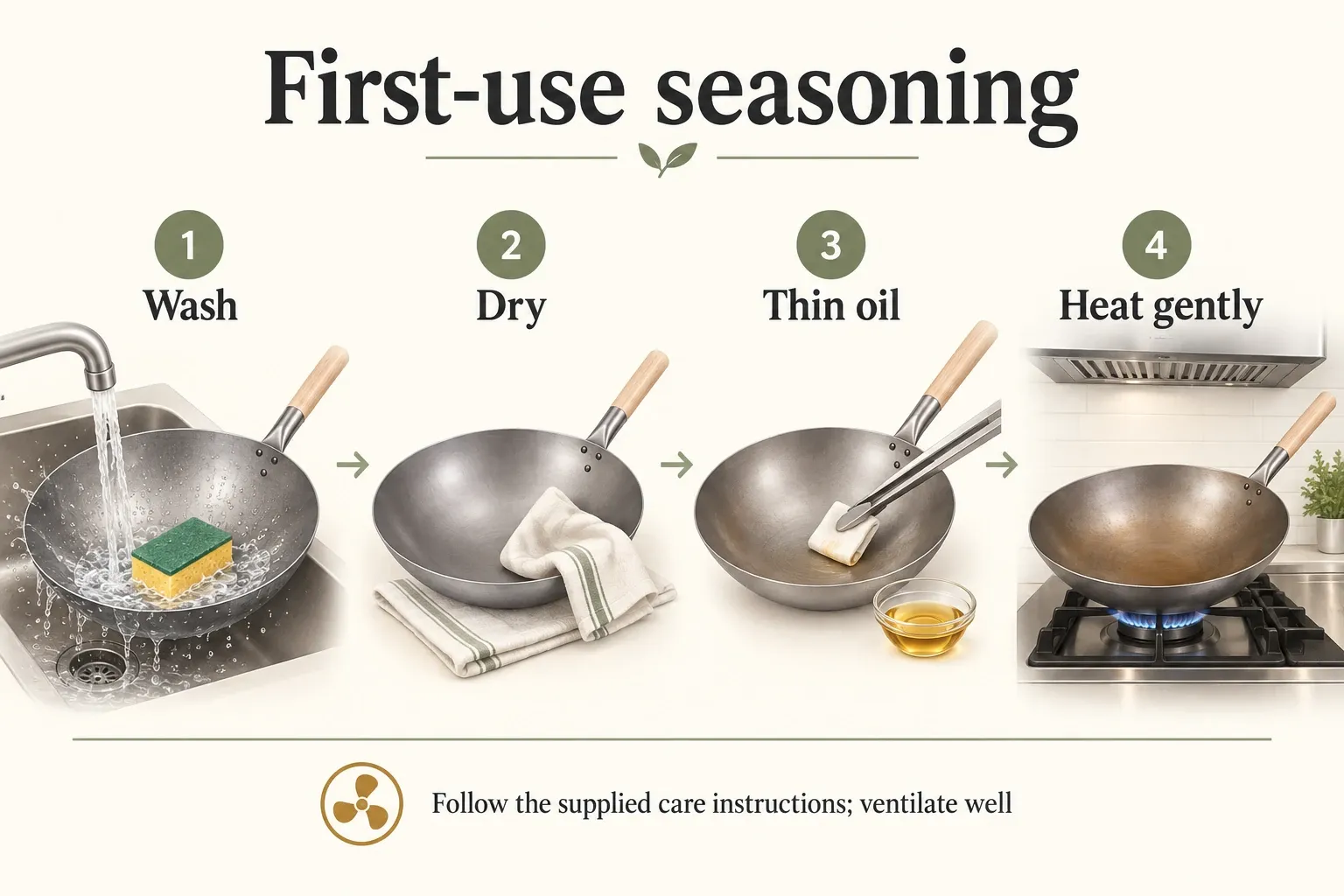
Step 1: One wash with hot water and dish soap
Wash the new wok in hot water with a little dish soap, scrubbing with a soft sponge to remove the factory rust-proof oil — the only time the wok meets soap, since soap later strips the oil layer you are building. Rinse and towel-dry immediately.
Step 2: Heat, thin oil, repeat
- Place the dry wok over moderate heat until remaining moisture evaporates.
- Wipe the inside with a thin film of cooking oil — less oil, more rounds.
- Keep it on the heat in a well-ventilated kitchen until the film darkens and the surface turns from silver toward bronze; a light shimmer or faint smoke is normal, so keep the coats thin.
- Cool slightly, wipe, and repeat with two or three more thin coats.
The wok will not look black on day one — that is fine. The seasoning deepens every time you cook.
Already pre-seasoned? The shorter version
Pre-seasoned models such as YH-CSW-302 and YH-CSW-203 leave the factory with an applied seasoning layer on the cooking surface, so the full process above is not required: wash once, dry well, wipe with a little oil, and start cooking. Because listings can pair the seasoning layer with a rust-proof oil coating for storage and transport, follow the first-use instructions confirmed for your order — "pre-seasoned" and "maintenance-free" are not the same claim.
Forwardable: Four Daily Habits That Protect the Seasoning
- Hot wok first, oil after. Add oil to a preheated wok shortly before the food goes in; a cold start causes most sticking.
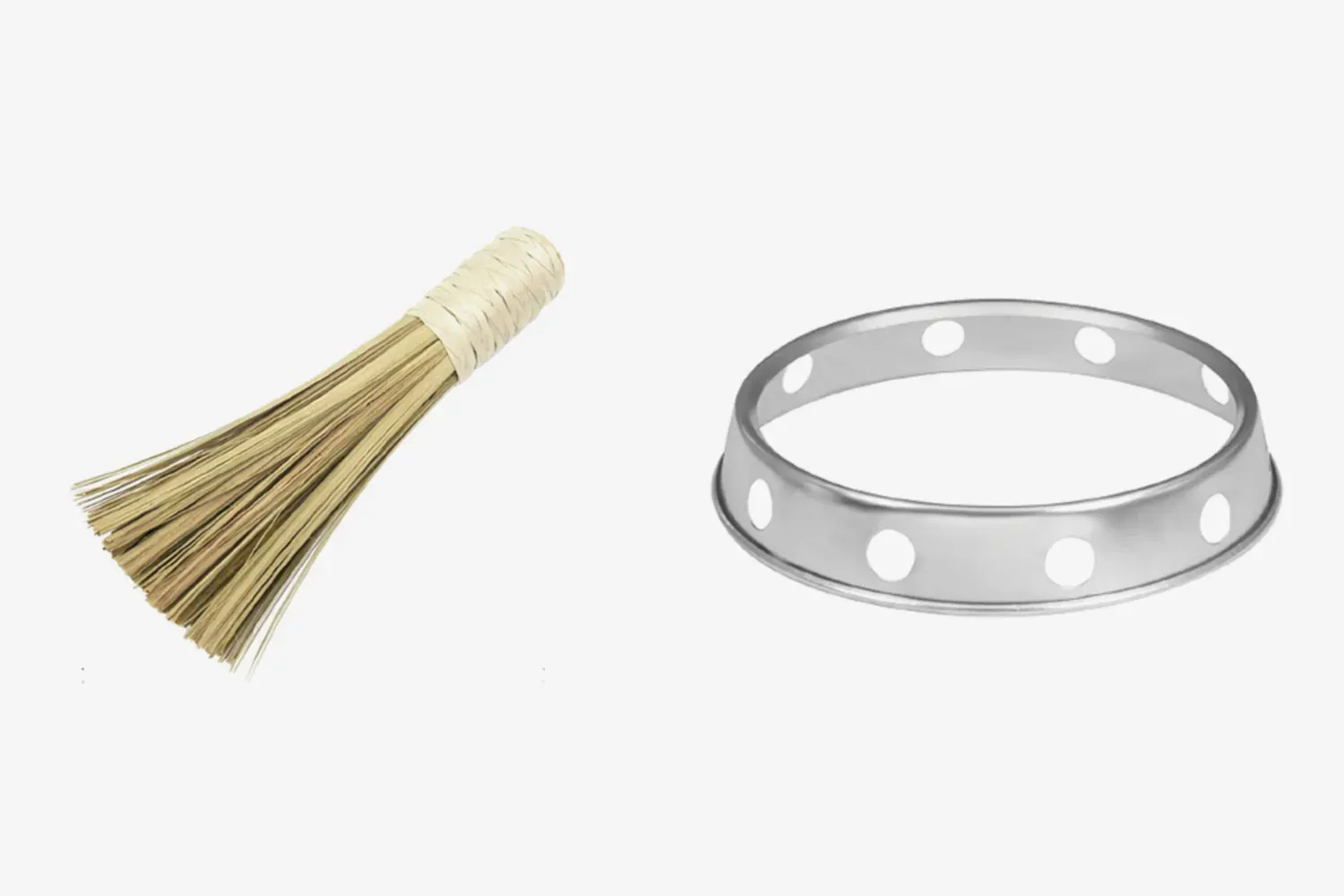
- Hot-water rinse, no soaking. Rinse while the wok is warm and scrub gently — a YH-ACC-110 bamboo wok brush is made for exactly this job.
- Dry on the stove. Set the rinsed wok over low heat for a minute to drive off moisture, then wipe dry.
- Thin oil before storage. Wipe the surface with a drop of oil and store the wok dry.
For round-bottom woks on open burners, a YH-ACC-109 stainless steel wok ring keeps the wok stable on the grate — safer handling, less scraping of the seasoned surface.
The One-Page Care Checklist: Rhythm at a Glance
| Stage | What the customer does | Time involved |
|---|---|---|
| First seasoning (natural-finish woks) | Soap wash once → dry fully → thin-oil coats, heated and repeated 2–3 times | About half an hour |
| After every use | Hot-water rinse, gentle brush, no soaking → dry on the stove → thin oil wipe | 2–3 minutes |
| Monthly (or when the surface dulls) | Warm the wok, apply a thin oil coat, brief reheat, wipe | About 10 minutes |
| Rust rescue | Scrub off rust, wash, dry completely, re-oil, re-season with one or two coats | One session |
Copy-Paste Customer Message (Ready to Send)
> Welcome to your new carbon steel wok! Before the first cook: wash it once with hot water and a little dish soap to remove the factory protective oil, then towel-dry. Heat the empty wok, wipe the inside with a thin film of cooking oil, and let it heat until the surface deepens in color — thin coats, two or three rounds, ventilated kitchen. After that: rinse with hot water (no soaking), dry on the stove, wipe with a drop of oil before storing. Pre-seasoned model? The factory layer is already on — wash, dry, light oil, and start. See rust? Scrub it off, dry well, oil it, and cook on.
Turn It Into a Care Card
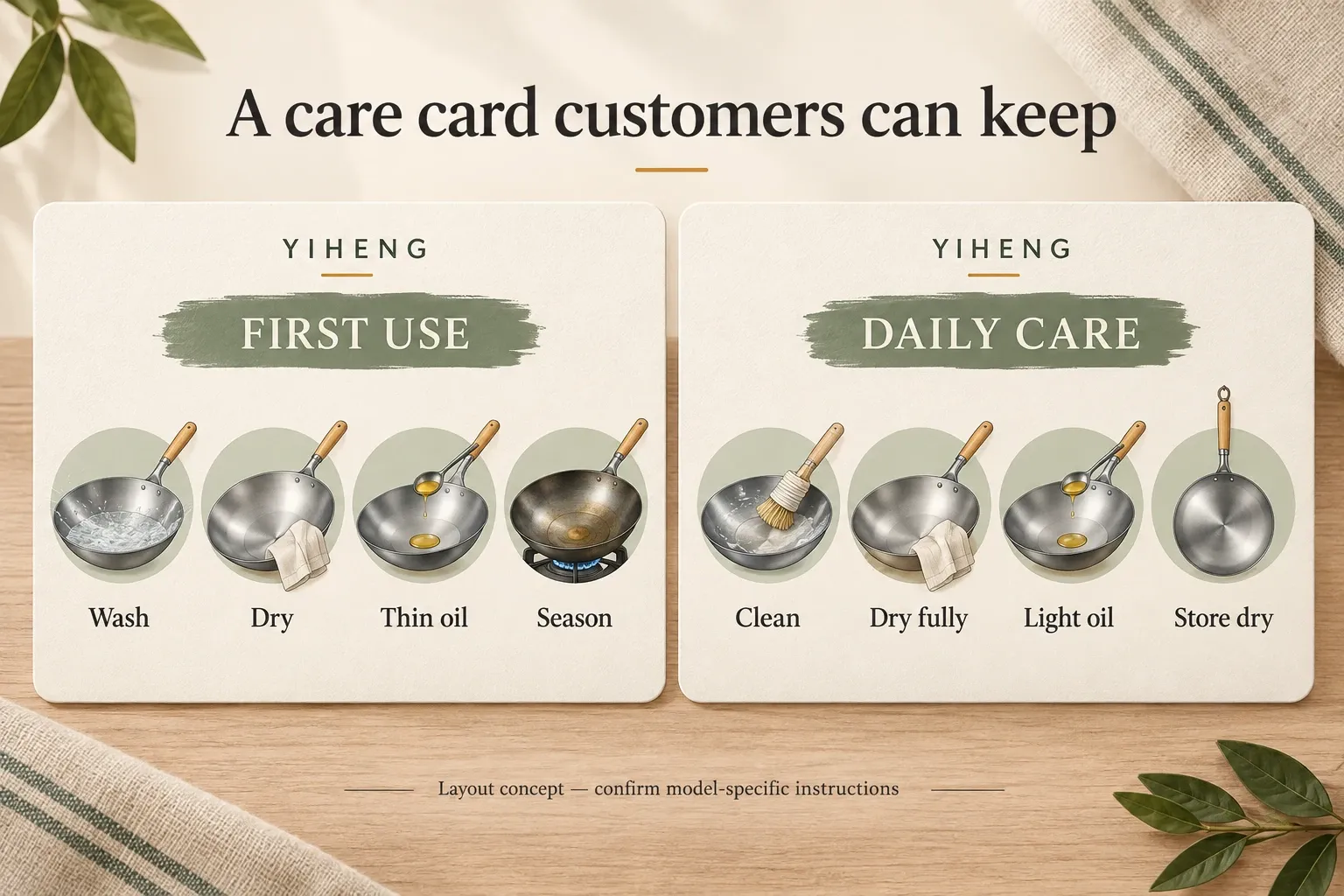
The guide fits a two-sided card with a QR code linking to this page. Front — first use: wash once (the only soap wash) → dry → thin oil, heat, repeat 2–3 times. Back — daily and rescue: rinse hot, no soaking → dry on stove → thin oil before storage; rust: scrub, dry, oil, re-season. YIHENG provides an English, print-ready Wok Care Card template to trade customers, and care copy for your retail packaging is confirmed with your order details.
A Simple Add-On at Checkout
Care is where the accessories earn their place: a wok plus a bamboo wok brush (YH-ACC-110) plus a wok ring for round-bottom models (YH-ACC-109) makes a natural care bundle for gas-stove markets. The wider accessory assortment is its own topic; here they are simply care companions.
Retailer Note: Pre-Seasoned vs Natural Finish
On the shelf, the after-sales script differs by factory finish. A pre-seasoned model supports a simple "wash once and cook" message; a natural-finish model needs the full first-seasoning ritual communicated up front, or the customer meets rust in week one. Market neither finish as "maintenance-free" — carbon steel is a use-it-and-maintain-it material. Which finish to stock is a buying decision (see the guide linked at the top); a fuller surface-finish matrix follows later in this series.
From the Factory Side
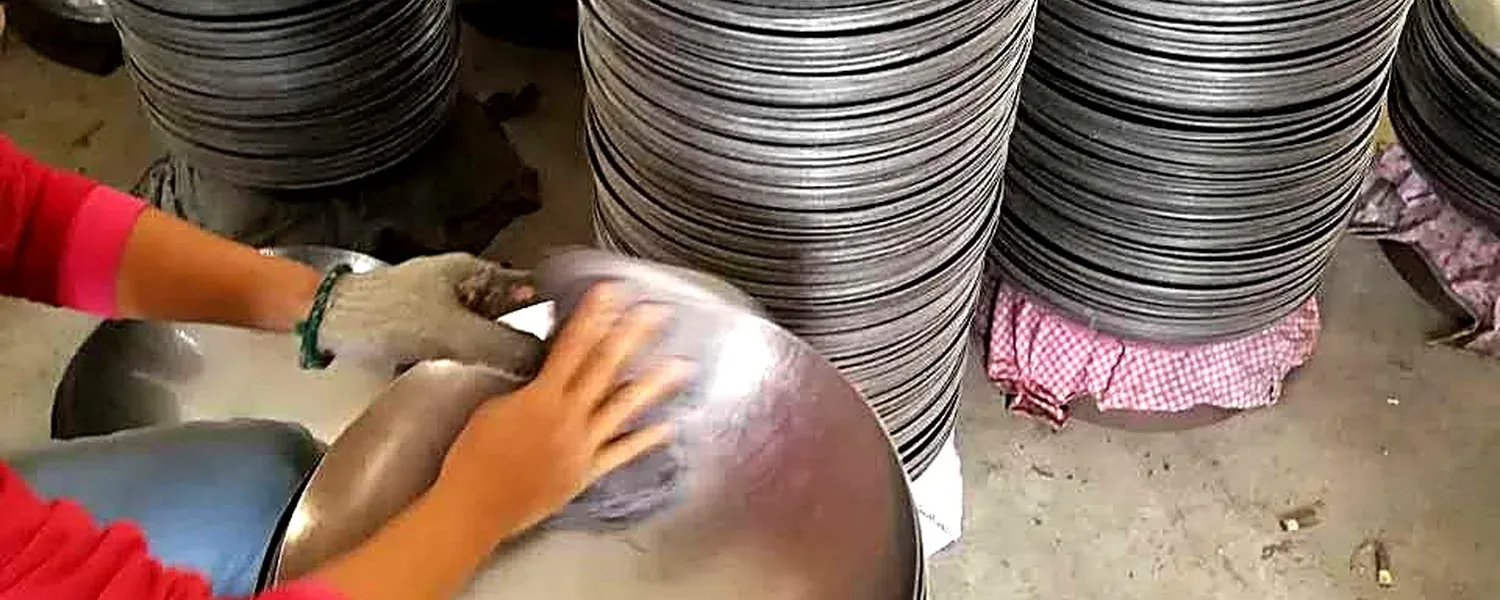
Natural-finish models ship with their rust-proof oil film, pre-seasoned models with an applied seasoning layer, and wok surfaces pass a hand-polishing quality-check station before packing. Food-contact documentation is provided as certification support per market and model, subject to test reports (FDA/LFGB options as applicable to the destination market).
Frequently asked questions
My seasoned wok still sticks — what am I doing wrong?
Usually one of three things: the seasoning is still young, the wok was not fully preheated before oil and food went in, or too much food went in at once and dropped the temperature. Keep cooking — sticking fades as the layers build.
My towel comes away black when I wipe the wok. Is that dangerous?
No — normal in the first weeks. The residue is excess oil that carbonized during seasoning plus fine iron particles, and it tapers off as the surface stabilizes. Wash as usual, dry, continue.
My wok has rust spots. Can it be saved, and how do I store it?
Yes. Scrub the rust off with a brush or scouring pad, wash, dry completely on the stove, wipe with oil, and give it one or two fresh seasoning coats. To prevent a repeat: store the wok fully dry, and place a paper towel between stacked woks to trap moisture.
Get the Care Card Template and the Care Bundle
Write to us and we will reply with the template files and bundle details:
- Get the printable Wok Care Card template (EN, print-ready) — a two-sided English card to print as-is or rebrand, plus QR-code copy pointing customers back to this guide.
- Ask about the wok + bamboo brush + wok ring retail bundle — YH-CSW-302 or YH-CSW-203 quoted with YH-ACC-110 and YH-ACC-109 as a shelf-ready care kit.